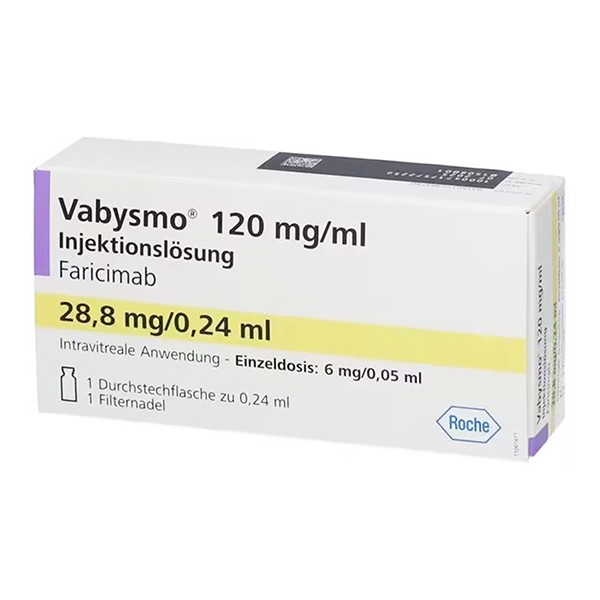


Vabysmo (faricimab) is an innovative bispecific antibody drug that simultaneously inhibits vascular endothelial growth factor (VEGF) and angiopoietin-2 (Ang-2). It has demonstrated significant efficacy in the treatment of ophthalmic diseases such as neovascular age-related macular degeneration (nAMD), diabetic macular edema (DME), and macular edema following retinal vein occlusion (RVO).
Dosage and Administration of Vabysmo (Faricimab)
Route of Administration and Dosage Specifications
Vabysmo must be administered via intravitreal injection and only by a qualified physician.
The drug is supplied as 6 mg (0.05 mL of a 120 mg/mL solution) in two packaging forms: prefilled syringes and vials.
Prefilled syringes are equipped with a sterile injection filter needle (30G × ½ inch ultra-thin wall), and each syringe is for single-eye use only.
Dosage Regimens for Different Indications
Neovascular Age-Related Macular Degeneration (nAMD): The recommended dose is 6 mg, administered 4 times at 4-week intervals (approximately every 28 ± 7 days) during the initial phase. Subsequent injection plans will be determined based on optical coherence tomography (OCT) and visual acuity assessment results at Weeks 8 and 12.
Diabetic Macular Edema (DME): One of two dosage regimens may be adopted: (a) 6 mg injected every 4 weeks for at least 4 doses, followed by adjustments based on central subfield thickness (CST) assessment; or (b) administration every 4 weeks for the first 6 treatments, followed by switching to every 8 weeks.
Macular Edema Following Retinal Vein Occlusion (RVO): 6 mg injected every 4 weeks for the first 6 months.
Key Pre-Injection Preparation Steps
For prefilled syringes: Remove the drug from refrigerated storage (2°C–8°C) and allow it to reach room temperature (20°C–25°C) at ambient temperature.
Strict aseptic technique must be maintained during handling: Remove the syringe cap, attach the injection filter needle, expel air bubbles, and accurately adjust the dose to the 0.05 mL mark.
Dosage Adjustments for Vabysmo (Faricimab)
Based on Disease Activity Assessment
After completing the initial treatment, physicians should monitor patient responses using professional assessment tools and develop individualized subsequent treatment plans.
For diabetic macular edema patients in particular, the dosing interval may be extended in 4-week increments or shortened to 8-week intervals based on central subfield thickness and visual acuity assessment results.
Standardized Injection Procedure
Intravitreal injection must be performed under sterile conditions, including surgical hand disinfection, use of sterile gloves, sterile drapes, and a sterile eyelid speculum.
Adequate anesthesia and broad-spectrum microbial antiseptic should be administered before injection.
Medication in Special Populations for Vabysmo (Faricimab)
Pregnant and Lactating Women
There are no sufficient controlled studies confirming the safety of Vabysmo in pregnant women.
Animal studies have shown that intravenous administration to pregnant monkeys increases the incidence of miscarriage.
Vabysmo should not be used during pregnancy unless the potential benefit outweighs the risk.
Elderly Patients
Clinical studies have shown that approximately 58% of treated patients are over 65 years of age.
In these studies, no significant difference in efficacy was observed with increasing age, and no dosage adjustment is required.