

Enasidenib is an isocitrate dehydrogenase-2 (IDH2) inhibitor indicated for the treatment of relapsed or refractory acute myeloid leukemia (AML) with specific gene mutation types.
Indications for Enasidenib
Primary Indications
Enasidenib is primarily indicated for the treatment of relapsed or refractory acute myeloid leukemia (AML) in adult patients with an isocitrate dehydrogenase-2 (IDH2) mutation.
This medication is specifically targeted at the AML patient population harboring the IDH2 gene mutation, which can be identified using a U.S. FDA-approved detection method.
In clinical practice, Enasidenib is particularly intended for patients whose disease has relapsed after conventional treatment or who have failed to respond to prior therapy.
Confirmation of the IDH2 mutation in patients through specialized genetic testing is mandatory before initiating Enasidenib treatment, as this is a critical prerequisite for ensuring therapeutic efficacy.
Dosage Forms, Strengths, and Characteristics of Enasidenib
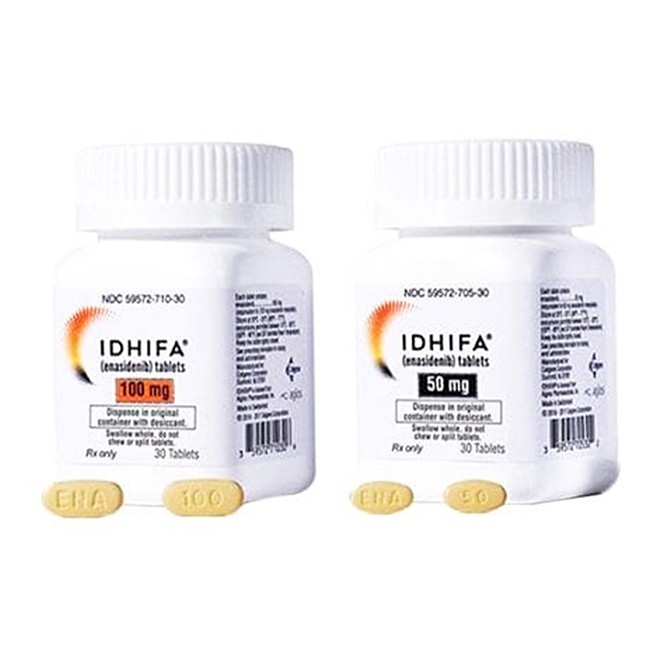
50 mg Tablets
Appearance: Light yellow to yellow, oval-shaped, film-coated tablets.
Imprint: "ENA" embossed on one side and "50" embossed on the other side.
100 mg Tablets
Appearance: Light yellow to yellow, capsule-shaped, film-coated tablets.
Imprint: "ENA" embossed on one side and "100" embossed on the other side.
Composition
In addition to the active ingredient enasidenib, the tablets contain the following excipients: colloidal silicon dioxide, hydroxypropyl cellulose, hypromellose acetate succinate, iron oxide yellow, magnesium stearate, microcrystalline cellulose, polyethylene glycol, polyvinyl alcohol, sodium lauryl sulfate, sodium starch glycolate, talc, and titanium dioxide.
Storage Instructions for Enasidenib
Temperature Requirements
Store the medication at a standard room temperature of 20°C to 25°C (68°F to 77°F), with allowable short-term storage within the range of 15°C to 30°C (59°F to 86°F).
Container Management
Special attention should be paid to maintaining the integrity of the original drug packaging during storage.
Enasidenib tablets must always be stored in the original bottle, and the desiccant container provided inside the bottle must remain in place to effectively protect the medication from moisture.
The bottle cap should be kept tightly closed, as this is a key measure to prevent moisture damage to the medication.
Handling Guidelines
For daily management, it is recommended to store the medication in a dry, cool environment, away from direct sunlight and humid conditions.
Immediately close the bottle cap after removing tablets from the bottle to ensure the remaining medication remains adequately protected.
Importantly, Enasidenib tablets should not be transferred from the original container to other pill boxes or containers, as this will compromise the original moisture-protection system.
Store the medication in a secure location out of the reach of children to prevent accidental ingestion.

Free Inquiry