info@seagull-health.com
SeagullHealth
语言:
search
new
What Are the Side Effects of Enasidenib?
511
Article source: Seagull Pharmacy
Nov 14, 2025

Enasidenib is a targeted medication for isocitrate dehydrogenase-2 (IDH2) mutations, indicated for adult patients with relapsed or refractory acute myeloid leukemia (AML). As a prescription-only drug, close attention must be paid to its potential side effects and medication-related risks during clinical use.

What Are the Side Effects of Enasidenib?

Common Side Effects

Gastrointestinal reactions: Nausea (50%), vomiting (34%), diarrhea (43%).

Metabolic and nutritional abnormalities: Decreased appetite (34%).

Abnormal Laboratory Indicators

Elevated bilirubin (81%), of which 15% are severe abnormalities of Grade 3 or higher.

Decreased blood calcium (74%), decreased blood potassium (41%), and decreased blood phosphorus (27%).

Some patients may experience taste disorders (12%), non-infectious leukocytosis (12%), etc.

Severe Side Effects of Enasidenib

Differentiation Syndrome

Incidence and risk: Approximately 14% of patients develop differentiation syndrome after receiving enasidenib treatment. Symptoms may occur within 1 day to 5 months of medication initiation and can be life-threatening in severe cases.

Typical manifestations: Fever, dyspnea, hypoxemia, pleural effusion, peripheral edema (rapid weight gain), bone pain, and liver/kidney function impairment.

Management measures: Upon suspicion of differentiation syndrome, initiate corticosteroid therapy (e.g., dexamethasone) and hemodynamic monitoring immediately; hospitalization may be required if necessary.

Embryofetal Toxicity

Animal studies have shown that enasidenib can cause embryonic death or developmental abnormalities.

Contraception recommendations: Females and males of reproductive potential must use effective non-hormonal contraceptive methods during treatment and for 2 months after the last dose.

Other Severe Adverse Reactions

Tumor lysis syndrome: Risk assessment should be conducted in advance, and electrolytes and renal function should be monitored.

Non-infectious leukocytosis: When the white blood cell count is significantly elevated (> 30 × 10⁹/L), hydroxyurea should be used in combination; enasidenib may need to be discontinued if necessary.

Precautions for Enasidenib Administration

Pre-Medication Screening and Dosage Standards

Genetic testing: Only applicable to AML patients with confirmed IDH2 mutations via FDA-approved testing methods.

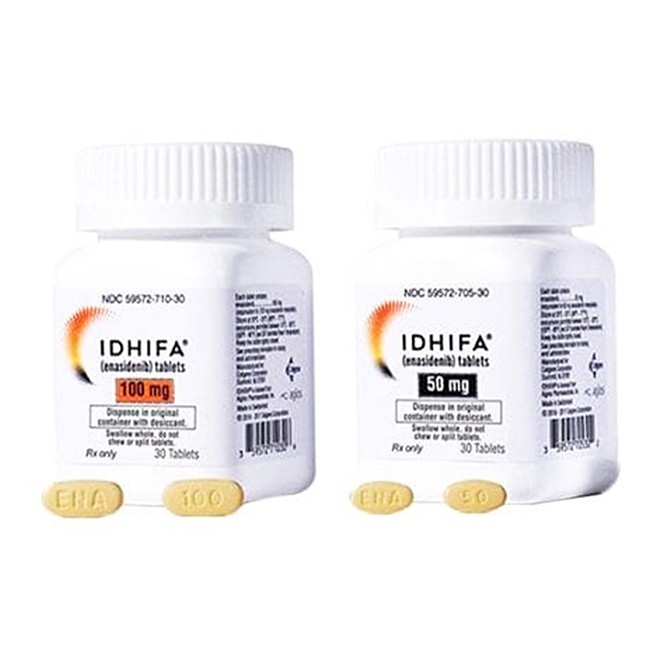
Recommended dosage: 100 mg orally once daily, with or without food; the tablet must be swallowed whole.

Dosage adjustment: Discontinue or reduce the dosage to 50 mg/day based on toxicity grading (see Table 1); permanent discontinuation is required in case of severe recurrence of toxicity.

Management of Drug Interactions

Enasidenib may affect the efficacy of co-administered drugs by inhibiting or inducing hepatic enzymes and transporters.

Avoid co-administration: Substrates of CYP1A2, CYP2C19, CYP3A, and OATP1B1/BCRP (e.g., certain antifungal drugs, hormonal contraceptives).

Monitoring requirements: When co-administered with P-glycoprotein substrates (e.g., digoxin), enhanced monitoring of adverse reactions is required.

Administration in Special Populations

Pregnant women: Contraindicated due to the risk of teratogenicity.

Lactating women: Breastfeeding is prohibited during treatment and for 2 months after drug discontinuation.

Elderly patients: No dosage adjustment is required, but close monitoring of liver/kidney function and hematological indicators is necessary.

Note: For internal discussion among medical personnel only. For specific medication, please consult the attending physician. Drug information may change over time. For the latest information, we recommend adding a medical consultant or consulting for free online.
Enasidenib(Idhifa)
Enasidenib(Idhifa)
Treatment of relapsed or refractory acute myeloid leukemia (AML) in adult...
WeChat Scan
Free Inquiry
Recommended Articles
What are the Precautions for Taking Enasidenib?
Enasidenib is an isocitrate dehydrogenase-2 (IDH2) inhibitor that provides a targeted treatment option for patients with relapsed or refractory acute myeloid leukemia (AML).What are the Precautions fo...
Dosage and Administration of Enasidenib
Enasidenib is an isocitrate dehydrogenase-2 (IDH2) inhibitor approved by the U.S. Food and Drug Administration (FDA) for the treatment of adult patients with relapsed or refractory acute myeloid leuke...
Indications for Enasidenib
Enasidenib is an isocitrate dehydrogenase-2 (IDH2) inhibitor indicated for the treatment of relapsed or refractory acute myeloid leukemia (AML) with specific gene mutation types.Indications for Enasid...
Procurement Channels for Enasidenib
Enasidenib is a targeted medication for the treatment of relapsed or refractory acute myeloid leukemia (AML). Its rational use is of crucial importance to patients. Due to the specific nature of this ...
What Are the Indications of Dimemorfan Phosphate Tablets (Astomin)?
Dimemorfan Phosphate Tablets (Astomin) are non-narcotic central antitussives. Owing to their low side effects and low addictiveness, they exhibit unique value in clinical practice.What Are the Indicat...
What Are the Precautions for Taking Dimemorfan Phosphate Tablets (Astomin)?
Dimemorfan Phosphate Tablets (Astomin) are a type of non-narcotic central antitussive. Since its first approval in Japan in 1975, it has been widely used to relieve cough symptoms in adults due to its...
Procurement Channels for Epalrestat
Epalrestat is an aldose reductase inhibitor that was first approved in Japan in 1992. It is mainly used for the treatment of diabetic peripheral neuropathy. Its mechanism of action involves inhibiting...
What Are the Indications of Epalrestat?
Epalrestat is an aldose reductase inhibitor that holds an important position in the treatment of diabetic complications. Since its first approval in Japan in 1992, it has become one of the key medicat...
Related Articles
​Enasidenib: Indications, Contraindications, and Dosage Guidelines for Special Populations
Enasidenib is a targeted agent against IDH2 mutations, used for the precise treatment of specific types of acute myeloid leukemia.I. Indications: Precision Targeting of IDH2 Mutations1. Sole Indicatio...
Complete Analysis of Enasidenib: Mechanism of Action, Drug Interactions, and Missed Dose Management
Enasidenib is an oral targeted therapy indicated for relapsed or refractory acute myeloid leukemia with IDH2 mutations.I. What is Enasidenib?1. Drug Profile(1) Enasidenib (brand name: IDHIFA) is an is...
Enasidenib: Dosage, Precautions, and Healthy Lifestyle Guidelines
Proper administration of enasidenib, avoidance of treatment risks, and adoption of a healthy lifestyle are critical to enhancing therapeutic efficacy and ensuring safety.1. Dosage and Administration1....
Enasidenib: Side Effects, Management Strategies, and Storage Guidelines
While treating IDH2-mutant acute myeloid leukemia (AML), enasidenib may cause various adverse reactions.I. Common Side Effects of Enasidenib1. Adverse Reactions with an Incidence Rate ≥ 20%Based on cl...
Enasidenib Dosage and Administration, Recommended Dose
Enasidenib is an isocitrate dehydrogenase-2 (IDH2) inhibitor indicated for the treatment of adult patients with relapsed or refractory acute myeloid leukemia (AML) harboring an IDH2 mutation.Enasideni...
Side Effects of Enasidenib
Enasidenib is a targeted therapeutic agent for the treatment of relapsed or refractory acute myeloid leukemia (AML) with an isocitrate dehydrogenase-2 (IDH2) mutation.Side Effects of EnasidenibGastroi...
What are the Precautions for Enasidenib Use?
Enasidenib is an oral targeted therapy drug for adult patients with relapsed or refractory acute myeloid leukemia (AML) harboring an isocitrate dehydrogenase 2 (IDH2) mutation. It was first approved f...
What are the indications for Enasidenib?
Enasidenib is an oral targeted therapy drug, marketed under the brand name IDHIFA®, which was first approved for marketing in the United States in 2017. It is an isocitrate dehydrogenase-2 (IDH2) inhi...
New Drugs
Infigratinib(Truseltiq)
Treatment of previously treated, unresectable locally advanced or metastatic...
Opicapone(Ongentys)
Opicapone(Ongentys)
Adjunctive treatment to levodopa/carbidopa for reducing "off" episodes in...
Deflazacort(Emflaza)
Treatment of Duchenne muscular dystrophy (DMD) in patients aged 2 years and...
Faricimab-svoa(Vabysmo)
Treatment of neovascular age-related macular degeneration, diabetic macular...
Counselling Service
Global Drug Search
Clinical Research Recruitment
Overseas Medical Treatment
Remote Consultations
Note: Our medical consultant will contact you as soon as possible. We promise to strictly protect your privacy.
Submit
Business
  • Core products
  • Antitumor drugs
  • General drug
  • Antiviral drugs
  • Biological agents
Contact Us 
  • haiousales@gmail.com
Welcome to consult
Seagull Pharmacy.,Ltd All rights reserved