info@seagull-health.com
SeagullHealth
语言:
search
new
Indications of Infigratinib
501
Article source: Seagull Pharmacy
May 20, 2026

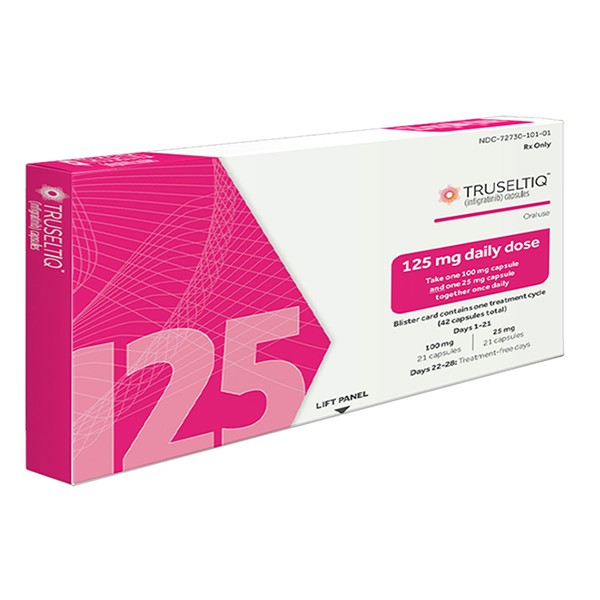
Infigratinib is an oral kinase inhibitor targeting FGFR2, indicated for patients with specific gene mutations in cholangiocarcinoma.

I. Indications

1. Infigratinib is indicated for adult patients with previously treated, unresectable locally advanced or metastatic cholangiocarcinoma.

2. Prior to use, the presence of an FGFR2 gene fusion or other rearrangement must be confirmed by an FDA-approved test.

II. Contraindications

1. No absolute contraindications:

(1) According to the prescribing information, infigratinib has no absolute contraindications.

(2) However, this does not mean all patients can safely use it; assessment should still be based on the patient's specific condition and concomitant medications.

2. Concomitant medications to avoid:

(1) Concomitant use with strong or moderate CYP3A inhibitors (e.g., itraconazole, clarithromycin) is prohibited, as they may significantly increase plasma concentrations and increase toxicity risk.

(2) Concomitant use with strong or moderate CYP3A inducers (e.g., rifampin, carbamazepine) is prohibited, as they may reduce efficacy.

(3) Avoid concomitant use with proton pump inhibitors.

III. Foods to avoid

1. Grapefruit and its products:

(1) Avoid eating grapefruit or drinking grapefruit juice during treatment.

(2) Components in grapefruit can inhibit CYP3A metabolic enzymes, potentially leading to significantly increased infigratinib plasma concentrations and increased risk of adverse reactions.

2. High-fat, high-calorie meals:

(1) Avoid taking the medication after a high-fat, high-calorie meal, as food can increase drug exposure by 80%-120%, increasing the incidence and severity of adverse reactions such as hyperphosphatemia.

(2) Take on an empty stomach (at least 1 hour before or 2 hours after a meal).

IV. Use in specific populations

1. Pregnant and breastfeeding women:

(1) Infigratinib can cause fetal harm; in animal studies, malformations, fetal growth retardation, and embryo-fetal death were observed at exposures below clinical exposure.

(2) Women of childbearing potential must have a negative pregnancy test before treatment and use effective contraception during treatment and for 1 month after the last dose.

(3) Male patients with female partners of childbearing potential should also use effective contraception during the same period.

Breastfeeding is prohibited during treatment and for 1 month after the last dose.

2. Patients with hepatic or renal impairment:

(1) For mild to moderate renal impairment (creatinine clearance 30-89 mL/min), the recommended dose is 100 mg once daily.

(2) Safety in severe renal impairment or dialysis patients has not been established.

(3) For mild hepatic impairment (total bilirubin >ULN-1.5×ULN, or AST >ULN), the recommended dose is 100 mg once daily; for moderate hepatic impairment (total bilirubin 1.5-3×ULN), the recommended dose is 75 mg once daily.

(4) Safety and dosage in severe hepatic impairment have not been established.

3. Elderly patients:

(1) In clinical studies, 33% of patients were aged ≥65 years, and 10% were ≥75 years.

(2) No overall differences in safety or efficacy were observed between elderly and younger adults; no special dose adjustment is needed.

4. Pediatric patients:

(1) Safety and efficacy have not been established.

(2) Animal studies showed skeletal toxicity in rats and dogs, and dental toxicity in rats at exposures below clinical exposure.

5. Males and females of reproductive potential:

(1) Verify that female patients of childbearing potential are not pregnant before treatment.

(2) Female patients and male patients with female partners of childbearing potential must use effective contraception during treatment and for 1 month after the last dose.

Note: For internal discussion among medical personnel only. For specific medication, please consult the attending physician. Drug information may change over time. For the latest information, we recommend adding a medical consultant or consulting for free online.
Infigratinib(Truseltiq)
Treatment of previously treated, unresectable locally advanced or metastatic...
WeChat Scan
Free Inquiry
Recommended Articles
Common Side Effects of Infigratinib
Infigratinib has shown clear efficacy in the treatment of FGFR2-mutant cholangiocarcinoma, but may also cause various side effects.I. Common Side Effects1. Ocular Side Effects:(1) The most common ocul...
What is Momelotinib?
Momelotinib is an oral kinase inhibitor indicated for the treatment of adults with intermediate or high-risk myelofibrosis with anemia, including primary and secondary myelofibrosis.I. What is Momelot...
What are the common side effects of Momelotinib
Momelotinib is a targeted therapy used for the treatment of intermediate/high-risk myelofibrosis with anemia. Understanding its common side effects, mastering management strategies, and proper storage...
Dosage and Administration Guidelines of Propafenone Hydrochloride (Rythmol)
Propafenone Hydrochloride (Rythmol) is a class Ic antiarrhythmic agent primarily used to prolong the time to recurrence of symptomatic atrial fibrillation (AF) and paroxysmal supraventricular tachycar...
Cevimeline: Indications, Contraindications, and Use in Special Populations
Cevimeline is a cholinergic agonist that primarily promotes salivation by stimulating M receptors in the salivary glands.I. Indications1. Core IndicationCevimeline is indicated only for the improvemen...
Major Side Effects of Cevimeline
Cevimeline is used to improve dry mouth caused by Sjögren's syndrome, but it may cause various side effects when used.I. Major Side Effects of Cevimeline1. Digestive System Side Effects(1) The mos...
Indications, contraindications, and use in special populations for Mercaptopurine Tablets
Mercaptopurine is a chemotherapy drug used to treat acute lymphoblastic leukemia. Clarifying its indications, contraindications, and key points for use in special populations is crucial for treatment ...
Mercaptopurine Tablets: Side Effect Management and Storage Guidelines
Mercaptopurine is a chemotherapy drug used to treat acute lymphoblastic leukemia. Understanding its side effects, mastering relief methods, and proper storage are crucial for treatment safety.1. Commo...
Related Articles
Indications of Infigratinib
Infigratinib is an oral kinase inhibitor targeting FGFR2, indicated for patients with specific gene mutations in cholangiocarcinoma.I. Indications1. Infigratinib is indicated for adult patients with p...
Common Side Effects of Infigratinib
Infigratinib has shown clear efficacy in the treatment of FGFR2-mutant cholangiocarcinoma, but may also cause various side effects.I. Common Side Effects1. Ocular Side Effects:(1) The most common ocul...
New Drugs
Infigratinib(Truseltiq)
Treatment of previously treated, unresectable locally advanced or metastatic...
Opicapone(Ongentys)
Opicapone(Ongentys)
Adjunctive treatment to levodopa/carbidopa for reducing "off" episodes in...
Deflazacort(Emflaza)
Treatment of Duchenne muscular dystrophy (DMD) in patients aged 2 years and...
Faricimab-svoa(Vabysmo)
Treatment of neovascular age-related macular degeneration, diabetic macular...
Counselling Service
Global Drug Search
Clinical Research Recruitment
Overseas Medical Treatment
Remote Consultations
Note: Our medical consultant will contact you as soon as possible. We promise to strictly protect your privacy.
Submit
Business
  • Core products
  • Antitumor drugs
  • General drug
  • Antiviral drugs
  • Biological agents
Contact Us 
  • haiousales@gmail.com
Welcome to consult
Seagull Pharmacy.,Ltd All rights reserved