

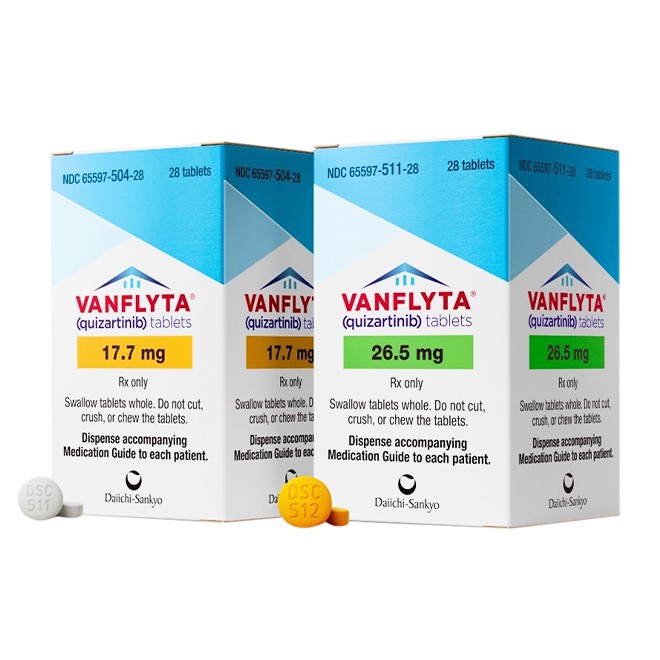
Quizartinib is a kinase inhibitor targeting the FLT3 receptor, which was first approved in the United States in 2023. In combination with standard induction therapy using cytarabine and anthracyclines, followed by cytarabine consolidation therapy, and as maintenance monotherapy after consolidation chemotherapy, this drug is indicated for the treatment of adult patients with newly diagnosed acute myeloid leukemia (AML) who test positive for FLT3 internal tandem duplication (ITD) via an FDA-approved detection method.
Dosage and Administration of Quizartinib
Standard Recommended Dosage
Induction phase: 35.4 mg orally once daily, starting from Day 8 (for the 7+3 regimen), administered for two weeks per cycle (Days 8-21).
Consolidation phase: 35.4 mg orally once daily, starting from Day 6, administered for two weeks per cycle (Days 6-19).
Maintenance phase: The initial dose is 26.5 mg orally once daily. If QTcF ≤ 450 ms, increase the dose to 53 mg once daily on Day 15.
Requirements for Administration Time
Administer orally at approximately the same time each day, either with food or on an empty stomach.
The tablets must be swallowed whole; do not cut, crush, or chew them.
If a dose is missed, take the missed dose as soon as possible on the same day, and resume the regular dosing schedule the next day.
Dose Adjustments of Quizartinib
Dose Adjustments Based on ECG Monitoring
QTcF 481-500 ms: Reduce the dose of quizartinib (without interruption of treatment).
QTcF > 500 ms: Discontinue administration temporarily; resume treatment at a reduced dose once QTcF returns to < 450 ms.
Recurrent QTcF > 500 ms: Discontinue the drug permanently.
Dose Adjustments for Adverse Reactions
For grade 3 or 4 non-hematologic adverse reactions: Discontinue administration temporarily. If the adverse reaction improves to grade 1 or lower, resume treatment at the previous dose.
If the adverse reaction improves to grade 2, resume treatment at a reduced dose.
If grade 3 or 4 adverse reactions persist for more than 28 days, discontinue the drug.
Dose Adjustments for Drug Interactions
Dose adjustment when used concomitantly with strong CYP3A inhibitors: If the current dose is 53 mg → adjust to 26.5 mg.
If the current dose is 35.4 mg → adjust to 17.7 mg.
If the current dose is 26.5 mg → adjust to 17.7 mg.
Use in Special Populations for Quizartinib
Patients with Renal Impairment
Mild to moderate renal impairment (creatinine clearance 30-89 mL/min): No dose adjustment is required.
Severe renal impairment (creatinine clearance < 30 mL/min): No studies have been conducted.
Patients with Hepatic Impairment
Mild (Child-Pugh Class A) or moderate (Child-Pugh Class B) hepatic impairment: No dose adjustment is required.
Severe hepatic impairment (Child-Pugh Class C): No studies have been conducted.
Pregnant and Lactating Women
Pregnancy: Based on animal study results and its mechanism of action, administration of quizartinib to pregnant women may cause fetal harm.
Lactation: Women are advised not to breastfeed during quizartinib treatment and for 1 month after the last dose.
Patients of Reproductive Age
Female patients: Use effective contraception during quizartinib treatment and for 7 months after the last dose.
Male patients: Use effective contraception during treatment and for 4 months after the last dose.

Free Inquiry