info@seagull-health.com
SeagullHealth
语言:
search
new
Precautions for Cobimetinib
500
Article source: Seagull Pharmacy
Aug 20, 2025
Cobimetinib (Cotellic) is a drug used to treat melanoma with BRAF V600E or V600K mutations, and it is administered in combination with Vemurafenib. BRAF V600E or V600K mutations are the most common types of mutations in melanoma, accounting for approximately 50%. These mutations lead to abnormal activation of the BRAF kinase, which in turn promotes the proliferation and growth of tumor cells. Cobimetinib works by inhibiting the activity of BRAF kinase, thereby blocking the mutant signaling pathway and reducing the growth and spread of tumor cells. At present, Cobimetinib has not been marketed in China. This article provides a detailed description of the precautions for Cobimetinib.

Precautions for Cobimetinib

Review the complete prescribing information for the combination of Cobimetinib and Vemurafenib to understand the serious risks associated with their combined use.

New Primary Malignant Tumors

Cobimetinib can cause new primary malignant tumors, both cutaneous and non-cutaneous.

(1) Cutaneous Malignant Tumors

A dermatological assessment should be performed before the start of treatment and every two months during treatment. Suspected skin lesions should be managed by excision and skin pathological evaluation. It is not recommended to adjust the dose of Cobimetinib. When used in combination with Vemurafenib, dermatological monitoring should be conducted within 6 months after discontinuing Cobimetinib.

(2) Non-cutaneous Malignant Tumors

Based on its mechanism of action, Vemurafenib may promote the growth and development of malignant tumors. Patients receiving the combination of Cobimetinib and Vemurafenib should be monitored for signs or symptoms of non-cutaneous malignant tumors.

Bleeding

(1) The use of Cobimetinib can lead to bleeding, including major bleeding defined as symptomatic bleeding in critical sites or organs.

(2) In case of grade 3 bleeding events, discontinue Cobimetinib. If the bleeding improves to grade 0 or 1 within 4 weeks, resume Cobimetinib at a lower dose level. Discontinue Cobimetinib in case of grade 4 bleeding events and grade 3 bleeding events that do not improve.

Cardiomyopathy

(1) The use of Cobimetinib can cause cardiomyopathy. The safety of Cobimetinib in patients with a baseline ejection fraction (LVEF) below the lower limit of normal (LLN) or below 50% of the LLN has not been established.

(2) Ejection fraction should be assessed before the start of treatment, 1 month after the start of treatment, and every 3 months thereafter until Cobimetinib is discontinued. Left ventricular dysfunction events should be managed by suspending treatment, reducing the dose, or discontinuing treatment. For patients restarting Cobimetinib treatment after dose reduction or suspension, ejection fraction should be assessed at approximately 2 weeks, 4 weeks, 10 weeks, and 16 weeks, and then as clinically indicated.

Severe Skin Reactions

Cobimetinib can cause severe rashes and other skin reactions. In such cases, suspend, reduce the dose, or discontinue Cobimetinib.

Serous Retinopathy and Retinal Vein Occlusion

Cobimetinib can cause ocular toxicity, including serous retinopathy (subretinal fluid accumulation). Regular ophthalmic assessments should be performed, and assessments should be conducted when patients report new or worsening visual disturbances. If serous retinopathy is confirmed, Cobimetinib should be suspended until visual symptoms improve. Serous retinopathy should be managed by suspending treatment, reducing the dose, or discontinuing treatment.

Hepatotoxicity

Cobimetinib can cause hepatotoxicity. Liver function tests should be monitored before starting Cobimetinib and monthly during treatment, or more frequently as clinically needed. If grade 3 or 4 liver function abnormalities occur, suspend, reduce the dose, or discontinue Cobimetinib.

Rhabdomyolysis

Cobimetinib can cause rhabdomyolysis. Baseline levels of serum creatine phosphokinase and creatinine should be measured before starting Cobimetinib, regularly during treatment, and when clinically indicated. If creatine phosphokinase is elevated, assess for signs and symptoms of rhabdomyolysis or other causes. Depending on the severity of symptoms or elevated creatine phosphokinase, administration may be suspended or discontinued.

Severe Photosensitivity Reactions

The use of Cobimetinib may cause photosensitivity reactions, including severe ones. It is recommended that patients avoid sun exposure, wear protective clothing, use broad-spectrum UVA/UVB sunscreens and lip balms (SPF ≥ 30) during outdoor activities. Dose adjustment should be made for grade 2 or higher photosensitivity reactions that are intolerable.

Embryo-Fetal Toxicity

Administration of Cobimetinib to pregnant women can cause harm to the fetus. Pregnant women should be informed of the potential risks to the fetus. Women of reproductive potential are advised to use effective contraception during treatment with Cobimetinib and for 2 weeks after the last dose of Cobimetinib.

Note: For internal discussion among medical personnel only. For specific medication, please consult the attending physician. Drug information may change over time. For the latest information, we recommend adding a medical consultant or consulting for free online.
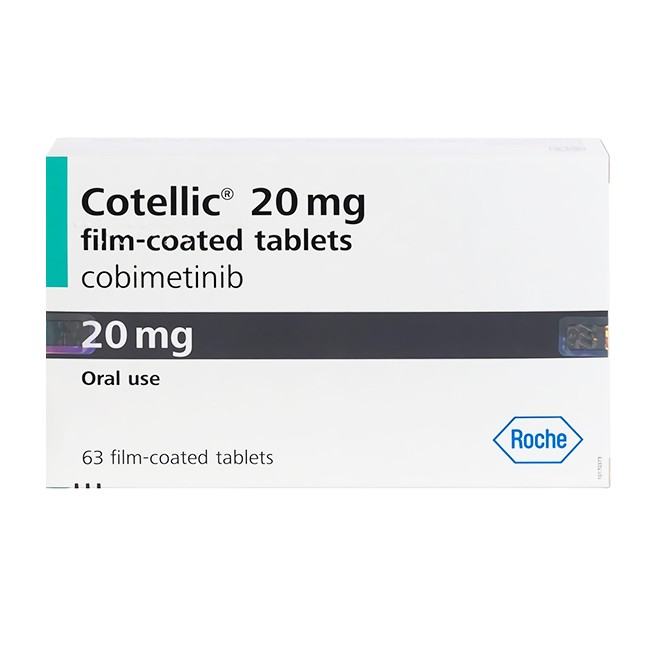
Cobimetinib(Cotellic)
Cotellic is indicated for the treatment of adult patients with melanoma...
WeChat Scan
Free Inquiry
Recommended Articles
Indications of Cobimetinib
Cobimetinib is an oral medication commonly used to treat adult patients with BRAF V600E or V600K mutations in unresectable or metastatic melanoma. It is usually used in combination with Vemurafenib to...
How to use cobimetinib?
Cobimetinib has not been marketed in China yet. Cobimetinib is a kinase inhibitor. It works by inhibiting the activity of BRAF kinase, blocking the mutant signaling pathway, and reducing the growth an...
Side Effects of Cobimetinib
Cobimetinib is a targeted therapy drug for unresectable or metastatic melanoma with BRAF V600E/K mutation positivity. It has excellent efficacy but is quite expensive. For patients, the question is ho...
What are the purchasing channels for Cobimetinib?
Cobimetinib, developed by Roche of Switzerland, is a targeted drug used to treat unresectable or metastatic melanoma with BRAF V600E/K mutation positivity. Up to now, it has not been marketed in China...
Defibrotide(Defitelio):Clinical Uses, Recommended Dosage, Treatment Effect
Defibrotide is a drug used to treat hepatic veno-occlusive disease (VOD). VOD is a rare but serious liver disease characterized by stenosis or obstruction of the hepatic veins, resulting in restricted...
Therapeutic Effects of Defibrotide
Defibrotide, as a commonly used medication, has gained widespread recognition for its efficacy in the treatment of various diseases. However, like many drugs, when used concurrently with other medicat...
Indications for Defibrotide
Defibrotide is a medication used to treat hepatic veno-occlusive disease (VOD). Before deciding whether to use defibrotide, doctors will evaluate the patient's condition and related factors. This ...
How much does Defitelio cost per box?
Defibrotide is a mixture of single-stranded oligonucleotides derived from the genomic DNA of calf lung or porcine intestinal mucosa. It is indicated for adult and pediatric patients with hepatic veno-...
Related Articles
What Are the Side Effects of Cobimetinib (Cotellic)?
Cobimetinib (Cotellic) is an important kinase inhibitor that plays a key role in the treatment of melanoma and histiocytic neoplasms.What Are the Side Effects of Cobimetinib (Cotellic)?Typical Reactio...
Precautions for Using Cobimetinib (Cotellic)
Cobimetinib (Cotellic) is a MEK inhibitor that demonstrates significant value in the treatment of BRAF V600 mutation-positive melanoma and histiocytic neoplasms. To ensure therapeutic benefits and min...
How to Use Cobimetinib (Cotellic)
Cobimetinib (Cotellic) is a kinase inhibitor primarily used in combination with other medications for the treatment of specific types of cancer.How to Use Cobimetinib (Cotellic)Standard Dosing Regimen...
Indications of Cobimetinib (Cotellic)
Cobimetinib (Cotellic) is a kinase inhibitor that plays an important role in the field of cancer treatment.Indications of Cobimetinib (Cotellic)Melanoma TreatmentCobimetinib, in combination with vemur...
How to Purchase Cobimetinib (Cotellic)
Cobimetinib (Cotellic) is an important kinase inhibitor primarily used for the treatment of certain types of melanoma and thyroid-like tumors. As a prescription medication, its purchase and use are su...
Precautions for Cobimetinib
Cobimetinib (Cotellic) is a drug used to treat melanoma with BRAF V600E or V600K mutations, and it is administered in combination with Vemurafenib. BRAF V600E or V600K mutations are the most common ty...
Indications of Cobimetinib
Cobimetinib is an oral medication commonly used to treat adult patients with BRAF V600E or V600K mutations in unresectable or metastatic melanoma. It is usually used in combination with Vemurafenib to...
How to use cobimetinib?
Cobimetinib has not been marketed in China yet. Cobimetinib is a kinase inhibitor. It works by inhibiting the activity of BRAF kinase, blocking the mutant signaling pathway, and reducing the growth an...
New Drugs
Infigratinib(Truseltiq)
Treatment of previously treated, unresectable locally advanced or metastatic...
Opicapone(Ongentys)
Opicapone(Ongentys)
Adjunctive treatment to levodopa/carbidopa for reducing "off" episodes in...
Deflazacort(Emflaza)
Treatment of Duchenne muscular dystrophy (DMD) in patients aged 2 years and...
Faricimab-svoa(Vabysmo)
Treatment of neovascular age-related macular degeneration, diabetic macular...
Counselling Service
Global Drug Search
Clinical Research Recruitment
Overseas Medical Treatment
Remote Consultations
Note: Our medical consultant will contact you as soon as possible. We promise to strictly protect your privacy.
Submit
Business
  • Core products
  • Antitumor drugs
  • General drug
  • Antiviral drugs
  • Biological agents
Contact Us 
  • mailbox:info@lucius.la
Welcome to consult
ucius Pharmaceuticals (Lao) Co.,Ltd All rights reserved