info@seagull-health.com
SeagullHealth
语言:
search
new
Precautions for Zongertinib Administration
503
Article source: Seagull Pharmacy
Oct 11, 2025

Zongertinib is a kinase inhibitor that targets activating mutations in the tyrosine kinase domain of HER2 (ERBB2). It is indicated for the treatment of adult patients with unresectable or metastatic non-squamous non-small cell lung cancer (NSCLC) who have previously received systemic therapy.

Precautions for Zongertinib Administration

Dosage and Administration

Dose Adjustment: The recommended dose of Zongertinib is determined based on body weight. Patients with a body weight of <90 kg should take 120 mg orally once daily, while those with a body weight of ≥90 kg should take 180 mg orally once daily.

Administration Time: Take the medication at a fixed time each day, either with food or on an empty stomach. The tablet must be swallowed whole; do not break, crush, or chew it.

Management of Missed Dose or Vomiting: If a dose is missed and less than 12 hours have passed since the scheduled time, the missed dose can be taken. If more than 12 hours have passed, skip the missed dose. In case of vomiting after administration, do not take an additional dose; proceed with the next scheduled dose as planned.

Contraindications and Special Populations

Pregnancy and Lactation: Zongertinib has embryo-fetal toxicity and is contraindicated in pregnant women. Women of childbearing potential must use effective contraceptive measures during treatment and for 2 weeks after the last dose. Lactating women should discontinue breastfeeding.

Hepatic and Renal Impairment: Patients with moderate to severe hepatic impairment or moderate to severe renal impairment should use Zongertinib with caution. Specific dose adjustments must be made based on clinical assessment.

Drug Interactions

Strong CYP3A Inducers: Drugs such as carbamazepine and rifampicin can significantly reduce the plasma concentration of Zongertinib. Concomitant use should be avoided. If co-administration is necessary, the dose of Zongertinib should be increased (e.g., from 120 mg to 240 mg for patients with a body weight of <90 kg).

BCRP Substrate Drugs: Concomitant use of Zongertinib with BCRP substrate drugs (e.g., rosuvastatin) may increase the toxicity of the latter. It is necessary to monitor for adverse reactions or adjust the dose accordingly.

Prevention of Adverse Reactions

Diarrhea: Diarrhea has a relatively high incidence (approximately 53%). In case of grade 2 or higher diarrhea, treatment should be suspended and anti-diarrheal therapy administered. If diarrhea persists without improvement, permanent discontinuation of the medication is required.

Rash and Nail Disorders: Maintain skin cleanliness and avoid irritation. For nail disorders, regular trimming is necessary to prevent infection.

Zongertinib Administration Monitoring

Hepatic Function Monitoring

Monitoring Frequency: Measure alanine aminotransferase (ALT), aspartate aminotransferase (AST), and total bilirubin at baseline and every 2 weeks during the first 12 weeks of treatment, then monthly thereafter. If an increase in liver enzymes is observed, the monitoring frequency should be increased.

Interventions: For grade 3 elevation of ALT/AST or grade 3 elevation of bilirubin: Suspend the medication; resume treatment at a reduced dose once indicators return to ≤grade 1.

Grade 4 Hepatic Injury or Hepatic Failure: Permanent discontinuation of the medication is required.

Cardiac Function Assessment

Left Ventricular Function: Evaluate left ventricular ejection fraction (LVEF) before starting treatment, and recheck it regularly during treatment (e.g., every 3 months).

If LVEF decreases to 40%-50% or drops by 10%-19% from baseline: Suspend the medication; if LVEF recovers within 4 weeks, treatment can be resumed at the original dose.

If LVEF <40% or symptomatic heart failure occurs: Permanent discontinuation of the medication is required.

Interstitial Lung Disease (ILD) Monitoring

Symptom Observation: Be alert to ILD/pneumonia in case of new or worsening dyspnea, cough, or fever.

Management Principles: For confirmed grade 2 ILD, suspend the medication and resume at a reduced dose after recovery. For grade 3 or higher ILD, permanent discontinuation of the medication is required.

Other Laboratory Monitoring

Complete Blood Count and Electrolytes: Focus on monitoring lymphopenia (9% of cases are grade 3-4) and hypokalemia (2.7% of cases are grade 3-4).

Pancreatic Enzymes: Regularly monitor amylase and lipase to be alert to the risk of pancreatitis.

Note: For internal discussion among medical personnel only. For specific medication, please consult the attending physician. Drug information may change over time. For the latest information, we recommend adding a medical consultant or consulting for free online.
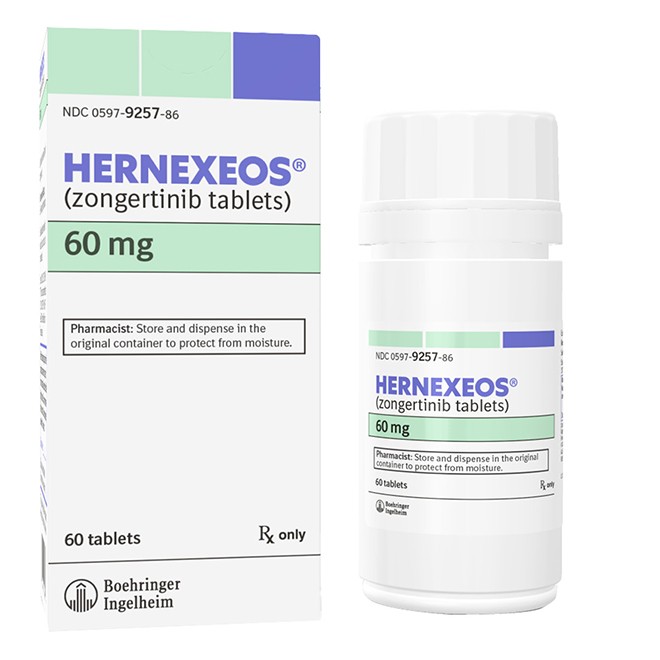
Zongertinib(Hernexeos)
Treatment of adult patients with advanced non-squamous non-small cell lung...
WeChat Scan
Free Inquiry
Recommended Articles
What Are the Side Effects of Zongertinib?
Zongertinib is a kinase inhibitor targeting activating mutations in the tyrosine kinase domain of HER2 (ERBB2). It is indicated for the treatment of unresectable or metastatic non-squamous non-small c...
How to Purchase Losartan Potassium and Hydrochlorothiazide Tablets (Hyzaar)
Losartan Potassium and Hydrochlorothiazide Tablets (Hyzaar) is a combined antihypertensive drug manufactured by Merck & Co., Inc. It is mainly used for the treatment of hypertension and reducing t...
How to Administer Losartan Potassium and Hydrochlorothiazide Tablets (Hyzaar)
Losartan Potassium and Hydrochlorothiazide Tablets (Hyzaar) is a combined antihypertensive drug composed of losartan potassium (an angiotensin II receptor blocker, ARB) and hydrochlorothiazide (a diur...
Precautions for Administration of Losartan Potassium and Hydrochlorothiazide Tablets (Hyzaar)
Losartan Potassium and Hydrochlorothiazide Tablets (Hyzaar) is a fixed-dose combination of losartan (an angiotensin II receptor blocker, ARB) and hydrochlorothiazide (a diuretic). It is widely used in...
How to Use Zongertinib
Zongertinib is a novel kinase inhibitor indicated for the treatment of adult patients with unresectable or metastatic non-squamous non-small cell lung cancer (NSCLC) harboring activating mutations in ...
Indication of Zongertinib
Zongertinib is a novel kinase inhibitor recently granted accelerated approval by the U.S. FDA. As a targeted therapy for specific patients with non-small cell lung cancer (NSCLC), its key information—...
How to Purchase Zongertinib
Zongertinib is a targeted therapeutic agent for non-small cell lung cancer (NSCLC) harboring activating mutations in the tyrosine kinase domain of HER2 (ERBB2). Due to its specificity and potential ef...
What Are the Side Effects of Cemiplimab?
Cemiplimab is a programmed death receptor-1 (PD-1) blocking antibody indicated for the treatment of patients with metastatic or locally advanced cutaneous squamous cell carcinoma (CSCC) who are not ca...
Related Articles
How to Purchase Zongertinib
Zongertinib is a targeted therapeutic agent for non-small cell lung cancer (NSCLC) harboring activating mutations in the tyrosine kinase domain of HER2 (ERBB2). Due to its specificity and potential ef...
Indication of Zongertinib
Zongertinib is a novel kinase inhibitor recently granted accelerated approval by the U.S. FDA. As a targeted therapy for specific patients with non-small cell lung cancer (NSCLC), its key information—...
How to Use Zongertinib
Zongertinib is a novel kinase inhibitor indicated for the treatment of adult patients with unresectable or metastatic non-squamous non-small cell lung cancer (NSCLC) harboring activating mutations in ...
Precautions for Zongertinib Administration
Zongertinib is a kinase inhibitor that targets activating mutations in the tyrosine kinase domain of HER2 (ERBB2). It is indicated for the treatment of adult patients with unresectable or metastatic n...
What Are the Side Effects of Zongertinib?
Zongertinib is a kinase inhibitor targeting activating mutations in the tyrosine kinase domain of HER2 (ERBB2). It is indicated for the treatment of unresectable or metastatic non-squamous non-small c...
What Are the Side Effects of Zongertinib?
Zongertinib is a kinase inhibitor that targets activating mutations in the tyrosine kinase domain of HER2 (ERBB2). It is used for the treatment of unresectable or metastatic non-squamous non-small cel...
Precautions for Zongertinib Administration
Zongertinib is a kinase inhibitor that targets activating mutations in the tyrosine kinase domain of HER2 (ERBB2). It is indicated for the treatment of adult patients with unresectable or metastatic n...
How to Use Zongertinib
Zongertinib is a novel kinase inhibitor indicated for the treatment of adult patients with unresectable or metastatic non-squamous non-small cell lung cancer (NSCLC) harboring activating mutations in ...
New Drugs
Infigratinib(Truseltiq)
Treatment of previously treated, unresectable locally advanced or metastatic...
Opicapone(Ongentys)
Opicapone(Ongentys)
Adjunctive treatment to levodopa/carbidopa for reducing "off" episodes in...
Deflazacort(Emflaza)
Treatment of Duchenne muscular dystrophy (DMD) in patients aged 2 years and...
Faricimab-svoa(Vabysmo)
Treatment of neovascular age-related macular degeneration, diabetic macular...
Counselling Service
Global Drug Search
Clinical Research Recruitment
Overseas Medical Treatment
Remote Consultations
Note: Our medical consultant will contact you as soon as possible. We promise to strictly protect your privacy.
Submit
Business
  • Core products
  • Antitumor drugs
  • General drug
  • Antiviral drugs
  • Biological agents
Contact Us 
  • mailbox:info@lucius.la
Welcome to consult
ucius Pharmaceuticals (Lao) Co.,Ltd All rights reserved