info@seagull-health.com
SeagullHealth
语言:
search
new
What Are the Side Effects of Enasidenib?
503
Article source: Seagull Pharmacy
Oct 17, 2025

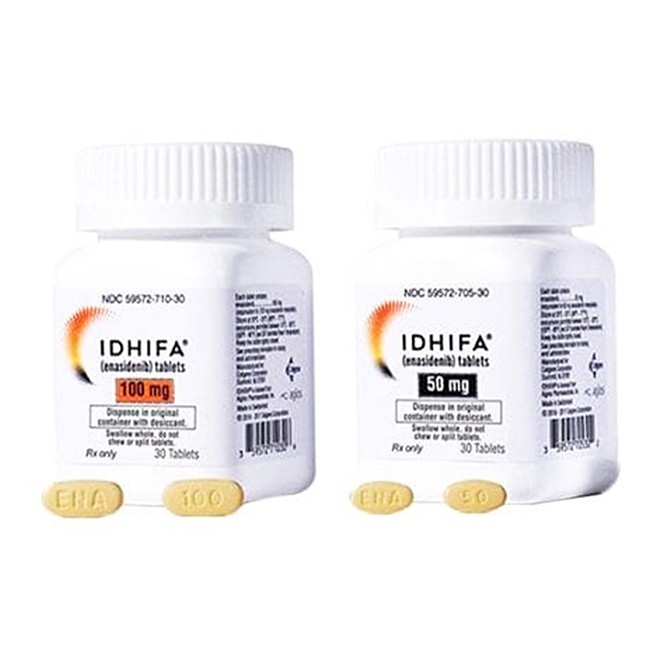
Enasidenib is an isocitrate dehydrogenase-2 (IDH2) inhibitor used to treat adult patients with relapsed or refractory acute myeloid leukemia (AML) who have an IDH2 mutation. As a targeted therapy, enasidenib provides therapeutic effects while also carrying certain adverse reactions and medication risks.

What Are the Side Effects of Enasidenib?

Common Side Effects

Gastrointestinal Reactions: Gastrointestinal symptoms such as nausea (50%), vomiting (34%), diarrhea (43%), and decreased appetite (34%) are relatively common, and most are mild to moderate.

Hematological Abnormalities: Non-infectious leukocytosis (12%), which is associated with drug-induced bone marrow proliferation.

Metabolic Abnormalities: Electrolyte disturbances including elevated blood bilirubin (81%), decreased blood calcium (74%), and decreased blood potassium (41%).

Neurological Symptoms: Taste disorders (12%), which are usually not severe.

Other Reactions: Systemic symptoms such as fatigue, fever, and weight loss.

Severe Side Effects of Enasidenib to Watch For

Differentiation Syndrome

Differentiation syndrome is the most serious complication during enasidenib treatment, with an incidence of approximately 14% and potential life-threatening risks.

Characteristic Manifestations Include:

Respiratory Symptoms: Dyspnea (68%), hypoxemia (76%), acute respiratory distress, pulmonary infiltrates (73%), and pleural effusion (45%).

Systemic Symptoms: Fever (36%), peripheral edema with rapid weight gain (21%), and lymphadenopathy (33%).

Organ Dysfunction: Renal impairment (70%), liver dysfunction, and multiple organ failure.

Embryo-Fetal Toxicity

Animal studies have shown that enasidenib can cause embryo-fetal death and growth abnormalities at doses equivalent to 0.1 times the human steady-state exposure.

Pregnant Women: Enasidenib is contraindicated; pregnancy status must be confirmed before medication use.

Contraception Requirements: Women of childbearing age should use effective contraceptive measures during treatment and for at least 1 month after discontinuing the drug. Male patients with reproductive partners should also use contraceptive measures during treatment and for 1 month after discontinuation.

Lactating Women: Breastfeeding is prohibited during treatment and for 1 month after discontinuing the drug.

Tumor Lysis Syndrome

Enasidenib may induce rapid reduction of tumor cells through promoting bone marrow proliferation, thereby triggering tumor lysis syndrome.

Before medication use, it is necessary to evaluate blood cell counts and blood biochemical indicators (especially white blood cell count and uric acid level). After starting treatment, monitoring should be conducted every 2 weeks for at least the first 3 months, and abnormal conditions should be addressed promptly.

Other Severe Reactions

Non-infectious Leukocytosis: Intervention is required when the white blood cell count exceeds 30×10⁹/L; treatment with hydroxyurea may be considered.

Elevated Bilirubin: When bilirubin remains ≥3 times the upper limit of normal for 2 weeks or more without elevated transaminases, the dose should be reduced to 50mg per day.

QT Interval Prolongation: Although no significant QT interval prolongation caused by enasidenib was observed in clinical trials, monitoring is still necessary.

Precautions for Enasidenib Use

Pre-Medication Assessment

Genetic Testing: IDH2 mutation must be confirmed using an FDA-approved testing method.

Baseline Examinations: Include complete blood count, blood biochemistry (with focus on white blood cell count, bilirubin, electrolytes, etc.), and electrocardiogram.

Pregnancy Testing: All women of childbearing age must undergo pregnancy testing before using the drug.

Drug Interactions

Hormonal Contraceptives: Enasidenib may alter their concentrations; additional or alternative contraceptive methods are recommended.

CYP3A4 Substrate Drugs: Their concentrations may be affected, requiring close monitoring.

UGT1A1 Substrate Drugs: Such as irinotecan, which may increase the risk of toxicity.

Patient Monitoring and Follow-Up

Hematological Indicators: Monitor at least every 2 weeks for a minimum of 3 months.

Liver Function: Focus on bilirubin levels.

Electrolytes: Especially ions such as calcium, phosphorus, and potassium.

Symptoms of Differentiation Syndrome: Particularly within the first few months of treatment.

Signs of Tumor Lysis Syndrome: Such as hyperuricemia and electrolyte disturbances.

Note: For internal discussion among medical personnel only. For specific medication, please consult the attending physician. Drug information may change over time. For the latest information, we recommend adding a medical consultant or consulting for free online.
Enasidenib(Idhifa)
Enasidenib(Idhifa)
Treatment of relapsed or refractory acute myeloid leukemia (AML) in adult...
WeChat Scan
Free Inquiry
Recommended Articles
How Effective Is Eltrombopag (Revolade) in Treatment?
Eltrombopag (Revolade) is an oral thrombopoietin receptor agonist that plays an important role in the treatment of various hematological diseases.How Effective Is Eltrombopag (Revolade) in Treatment?E...
What Are the Side Effects of Eltrombopag (Revolade)
Eltrombopag (Revolade) is a thrombopoietin receptor agonist used to treat specific types of thrombocytopenia and aplastic anemia. Although it has good efficacy, potential side effects and precautions ...
Indications for Eltrombopag (Revolade)
Eltrombopag (Revolade) is a thrombopoietin receptor agonist developed by GlaxoSmithKline, mainly used to treat thrombocytopenia caused by various reasons.Indications for Eltrombopag (Revolade)Chronic ...
How to Use Eltrombopag (Revolade)
Eltrombopag (Revolade) is a thrombopoietin receptor agonist, primarily used clinically for the treatment of chronic immune thrombocytopenia (ITP), chronic hepatitis C-associated thrombocytopenia, and ...
How Effective Is Enasidenib in Treatment?
Enasidenib is a targeted therapeutic drug mainly used for patients with specific types of acute myeloid leukemia (AML). As an isocitrate dehydrogenase-2 (IDH2) inhibitor, it provides a new treatment o...
Precautions for Enasidenib Use
Enasidenib is an isocitrate dehydrogenase-2 (IDH2) inhibitor indicated for the treatment of adult patients with relapsed or refractory acute myeloid leukemia (AML) who harbor IDH2 mutations. As a targ...
Indications for Anagrelide (Agrylin)
Anagrelide (Agrylin) is a thrombocytopenic agent primarily used to treat thrombocythemia caused by myeloproliferative neoplasms.Indications for Anagrelide (Agrylin)Reducing Elevated Platelet CountThis...
How to Use Enasidenib
Enasidenib is an isocitrate dehydrogenase-2 (IDH2) inhibitor used for the treatment of adult patients with relapsed or refractory acute myeloid leukemia (AML) who harbor IDH2 mutations.How to Use Enas...
Related Articles
What Are the Side Effects of Enasidenib?
Enasidenib is a targeted medication for isocitrate dehydrogenase-2 (IDH2) mutations, indicated for adult patients with relapsed or refractory acute myeloid leukemia (AML). As a prescription-only drug,...
What are the Precautions for Taking Enasidenib?
Enasidenib is an isocitrate dehydrogenase-2 (IDH2) inhibitor that provides a targeted treatment option for patients with relapsed or refractory acute myeloid leukemia (AML).What are the Precautions fo...
Dosage and Administration of Enasidenib
Enasidenib is an isocitrate dehydrogenase-2 (IDH2) inhibitor approved by the U.S. Food and Drug Administration (FDA) for the treatment of adult patients with relapsed or refractory acute myeloid leuke...
Indications for Enasidenib
Enasidenib is an isocitrate dehydrogenase-2 (IDH2) inhibitor indicated for the treatment of relapsed or refractory acute myeloid leukemia (AML) with specific gene mutation types.Indications for Enasid...
Procurement Channels for Enasidenib
Enasidenib is a targeted medication for the treatment of relapsed or refractory acute myeloid leukemia (AML). Its rational use is of crucial importance to patients. Due to the specific nature of this ...
How to Use Enasidenib
Enasidenib is an isocitrate dehydrogenase-2 (IDH2) inhibitor used for the treatment of adult patients with relapsed or refractory acute myeloid leukemia (AML) who harbor IDH2 mutations.How to Use Enas...
Precautions for Enasidenib Use
Enasidenib is an isocitrate dehydrogenase-2 (IDH2) inhibitor indicated for the treatment of adult patients with relapsed or refractory acute myeloid leukemia (AML) who harbor IDH2 mutations. As a targ...
How Effective Is Enasidenib in Treatment?
Enasidenib is a targeted therapeutic drug mainly used for patients with specific types of acute myeloid leukemia (AML). As an isocitrate dehydrogenase-2 (IDH2) inhibitor, it provides a new treatment o...
New Drugs
Infigratinib(Truseltiq)
Treatment of previously treated, unresectable locally advanced or metastatic...
Opicapone(Ongentys)
Opicapone(Ongentys)
Adjunctive treatment to levodopa/carbidopa for reducing "off" episodes in...
Deflazacort(Emflaza)
Treatment of Duchenne muscular dystrophy (DMD) in patients aged 2 years and...
Faricimab-svoa(Vabysmo)
Treatment of neovascular age-related macular degeneration, diabetic macular...
Counselling Service
Global Drug Search
Clinical Research Recruitment
Overseas Medical Treatment
Remote Consultations
Note: Our medical consultant will contact you as soon as possible. We promise to strictly protect your privacy.
Submit
Business
  • Core products
  • Antitumor drugs
  • General drug
  • Antiviral drugs
  • Biological agents
Contact Us 
  • mailbox:info@lucius.la
Welcome to consult
ucius Pharmaceuticals (Lao) Co.,Ltd All rights reserved