

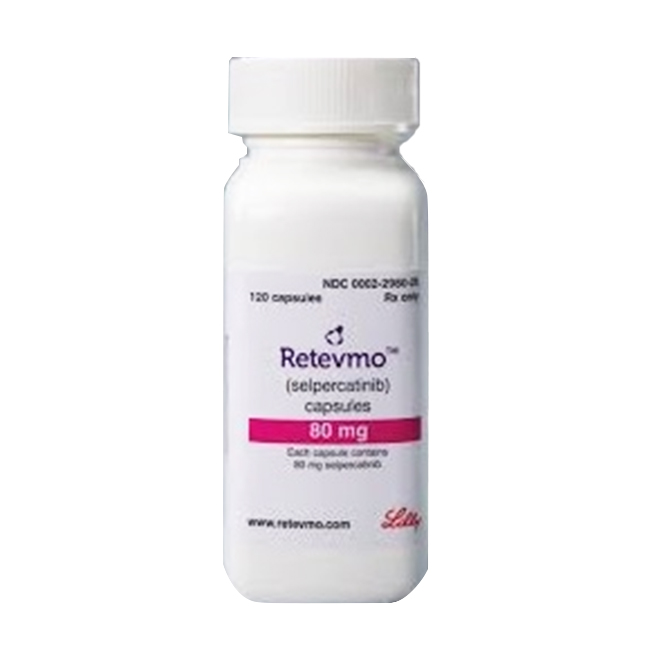
Selpercatinib (Retevmo) is a kinase inhibitor indicated for non-small cell lung cancer, medullary thyroid carcinoma, and thyroid cancer positive for RET gene fusion or mutation.
What are the precautions for the use of Selpercatinib (Retevmo)?
Genetic Testing Confirmation
Treatment is limited to patients with confirmed RET gene fusion (for non-small cell lung cancer or thyroid cancer) or specific RET gene mutation (for medullary thyroid cancer) by testing.
Patient selection should be based on test results from tumor specimens or plasma.
Baseline Condition Assessment
Liver Function: Alanine transaminase (ALT) and aspartate transaminase (AST) levels should be tested before treatment.
Blood Pressure: Treatment should not be initiated in patients with uncontrolled hypertension. Blood pressure control should be optimized before starting treatment.
Cardiac Risk: Careful evaluation is required for patients at significant risk of QT interval prolongation, such as those with known long QT syndrome, clinically significant bradycardia, or severe/uncontrolled heart failure.
Pregnancy Status: Females of reproductive potential must confirm they are not pregnant before starting treatment.
Planned Surgery: Communicate with the physician in advance if an elective surgery is planned in the near future.
Gastric Acid Reducing Agents
Concomitant use with proton pump inhibitors (PPIs), H2-receptor antagonists, or locally acting antacids should be avoided.
If unavoidable:
When co-administered with PPIs, selpercatinib should be taken with food.
When co-administered with H2-receptor antagonists, selpercatinib should be taken 2 hours before or 10 hours after their administration.
When co-administered with local antacids, selpercatinib should be taken 2 hours before or 2 hours after their administration.
CYP3A Inhibitors and Inducers
Concomitant use with strong or moderate CYP3A inhibitors (e.g., itraconazole, diltiazem) or inducers (e.g., rifampicin, bosentan) should be avoided.
If the use of inhibitors is unavoidable, the dose of selpercatinib should be reduced and the frequency of ECG monitoring increased according to the prescribing information.
CYP2C8/CYP3A Substrate Drugs
Selpercatinib inhibits CYP2C8 and CYP3A, which may increase plasma concentrations of related substrate drugs (e.g., repaglinide, midazolam), thereby increasing the risk of their adverse reactions.
Dose adjustment should be made with reference to the prescribing information of these drugs when used in combination.
Adverse Reaction Monitoring of Selpercatinib (Retevmo)
Hepatotoxicity
This is a common adverse reaction and may be severe.
Manifested as elevated AST and ALT.
Monitoring Requirements: Monitor ALT and AST before treatment, every 2 weeks during the first 3 months of treatment, and monthly thereafter.
Dose interruption, dose reduction, or permanent discontinuation may be required depending on severity.
Hypertension
Hypertension commonly occurs during treatment and may reach Grade 3 or 4 severity.
Monitoring Requirements: Monitor blood pressure 1 week after initiation of treatment and at least monthly thereafter.
Initiation or adjustment of antihypertensive agents, as well as dose adjustment or discontinuation of selpercatinib, may be required depending on blood pressure control.

Free Inquiry