

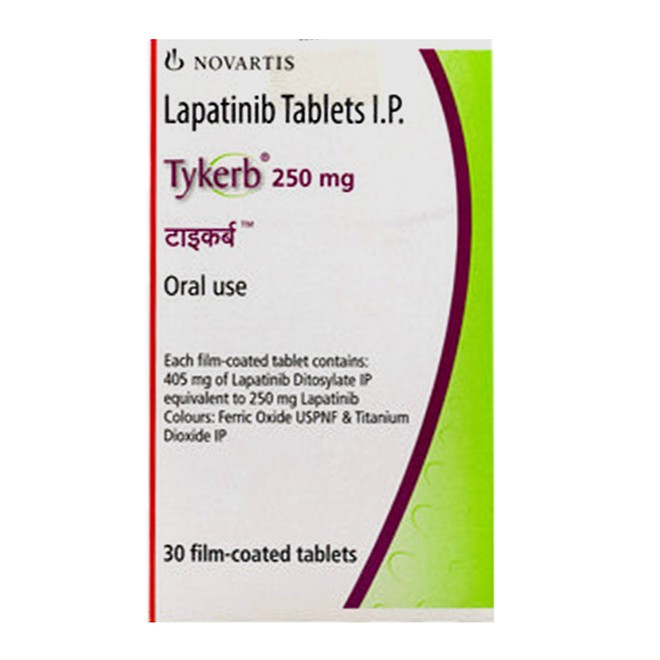
Lapatinib (Tykerb) is an oral small-molecule tyrosine kinase inhibitor used for the treatment of HER2-positive breast cancer.
How to Use Lapatinib (Tykerb)
Recommended Dosage
Combination with Capecitabine:
Take 1,250 mg (5 tablets) orally once daily for 21 consecutive days.
The dosage of capecitabine is 2,000 mg/m² per day, administered orally in 2 divided doses (with an interval of approximately 12 hours) on Days 1 to 14. A treatment cycle is 21 days.
Combination with Letrozole:
Take 1,500 mg (6 tablets) orally once daily.
The dosage of letrozole is 2.5 mg once daily.
Administration Precautions
Take the medication at least 1 hour before a meal or at least 1 hour after a meal.
The daily dosage should be taken in a single dose; do not split it into multiple doses.
Capecitabine should be taken with food or within 30 minutes after a meal.
If a dose is missed, do not take a double dose the next day to make up for it.
Dosage Adjustment of Lapatinib (Tykerb)
Cardiotoxicity
Discontinue the medication if the Left Ventricular Ejection Fraction (LVEF) decreases to Grade 2 or higher (per NCICTCAE v3.0 criteria) or falls below the institutional lower limit of normal.
If LVEF returns to normal within 2 weeks and there are no symptoms, the medication can be restarted at a reduced dose:
Reduce to 1,000 mg/day when combined with capecitabine.
Reduce to 1,250 mg/day when combined with letrozole.
Hepatotoxicity
Patients with severe hepatic impairment (Child-Pugh Class C) require dosage reduction:
Reduce to 750 mg/day when combined with capecitabine.
Reduce to 1,000 mg/day when combined with letrozole.
Permanently discontinue the medication if severe hepatotoxicity occurs.
Diarrhea
Suspend administration in case of Grade 3 diarrhea or Grade 1-2 diarrhea accompanied by complications.
After symptoms resolve to Grade 1, the medication can be restarted at a reduced dose:
Reduce to 1,000 mg/day when combined with capecitabine.
Reduce to 1,250 mg/day when combined with letrozole.
Permanently discontinue the medication in case of Grade 4 diarrhea.
Strong CYP3A4 Inhibitors
Concomitant use should be avoided (e.g., ketoconazole, itraconazole, clarithromycin, etc.).
If concomitant use is unavoidable, reduce the dose of lapatinib to 500 mg/day.
After discontinuing the inhibitor, a 1-week washout period is required before adjusting the dose of lapatinib.
Strong CYP3A4 Inducers
Concomitant use should be avoided (e.g., dexamethasone, phenytoin, carbamazepine, etc.).
If concomitant use is unavoidable, gradually increase the dose of lapatinib:
It can be increased to 4,500 mg/day when combined with capecitabine.
It can be increased to 5,500 mg/day when combined with letrozole.
After discontinuing the inducer, resume the original dose of lapatinib.
Medication for Special Populations of Lapatinib (Tykerb)
Pregnant Women
Animal studies have shown embryolethality and fetal malformations.
Human data are limited but suggest potential risks.
Confirm the pregnancy status before administering the medication.
Inform the patient of potential fetal risks.
Effective contraception is required during treatment and for 1 week after discontinuing the medication.
Patients with Hepatic Impairment
Mild to moderate hepatic impairment: No dosage adjustment is needed.
Severe hepatic impairment (Child-Pugh Class C): Dosage reduction is required.

Free Inquiry