

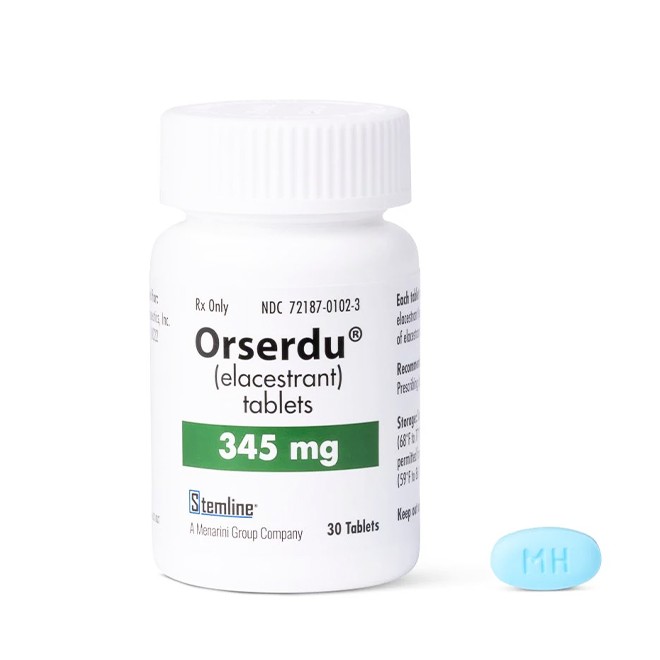
Elacestrant (Orserdu) is a selective estrogen receptor degrader (SERD), which provides an important treatment option for patients with estrogen receptor-positive, HER2-negative advanced or metastatic breast cancer harboring ESR1 mutations.
Dosage and Administration, Recommended Dose of Elacestrant (Orserdu)
Recommended Dose and Administration Method
The standard treatment regimen of elacestrant is 345 mg orally once daily, which should be taken with food to reduce the incidence of nausea and vomiting.
It is recommended to take the medication at a fixed time every day to ensure stable blood drug concentration.
If a dose is missed for more than 6 hours or vomiting occurs, do not take a supplementary dose and resume the next scheduled dose as planned.
Patient Selection Criteria
Before medication administration, the presence of ESR1 mutations in plasma samples must be confirmed using an FDA-approved testing method.
If the test result is negative, a comprehensive assessment should be conducted based on actual clinical conditions.
Dose Adjustment of Elacestrant (Orserdu)
Dose Reduction Ladder
First dose adjustment: Reduce to 258 mg orally once daily (equivalent to three 86 mg tablets).
Second dose adjustment: Reduce to 172 mg orally once daily (equivalent to two 86 mg tablets).
If further dose reduction is required, elacestrant must be permanently discontinued.
Management of Specific Adverse Reactions
Grade 1 adverse reactions: Continue treatment at the current dose level.
Grade 2 adverse reactions: Consider suspending medication until symptoms resolve to Grade 1 or below, then resume treatment at the original dose.
Medication in Special Populations of Elacestrant (Orserdu)
Patients with Hepatic Impairment
Mild hepatic impairment (Child-Pugh Class A): No dose adjustment is required.
Moderate hepatic impairment (Child-Pugh Class B): The recommended dose is adjusted to 258 mg orally once daily.
Severe hepatic impairment (Child-Pugh Class C): Elacestrant should be avoided.
Pregnancy and Lactation Management
Based on embryo-fetal toxicity observed in animal studies, the use of this drug in pregnant women may lead to adverse developmental outcomes.
It is recommended that women of childbearing potential confirm their pregnancy status before treatment, and adopt effective contraceptive measures during treatment and within 1 week after the last dose.
Lactating women should discontinue breastfeeding during treatment and within 1 week after the last dose.

Free Inquiry