info@seagull-health.com
SeagullHealth
语言:
search
new
What are the Precautions for Taking Elacestrant (Orserdu)?
502
Article source: Seagull Pharmacy
Dec 02, 2025

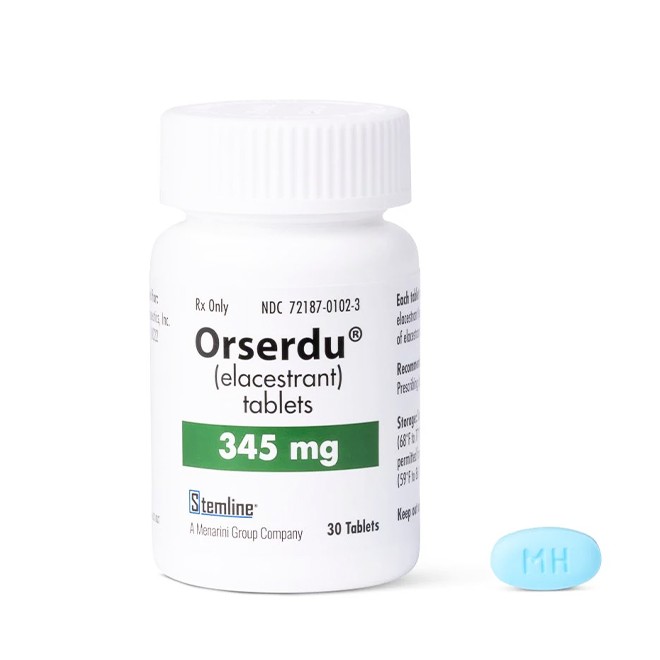
Elacestrant (Orserdu) is the first oral selective estrogen receptor degrader (SERD). It was approved by the FDA in 2023 for the treatment of advanced or metastatic breast cancer that is estrogen receptor (ER)-positive, human epidermal growth factor receptor 2 (HER2)-negative, and harbors ESR1 mutations. As an innovative endocrine therapy, its clinical application requires the establishment of a full-process monitoring system, ranging from genetic testing to long-term adverse reaction management.

What are the Precautions for Taking Elacestrant (Orserdu)?

Genetic Testing Verification

Before initiating treatment, the presence of missense mutations in the ligand-binding domain (codons 310-547) of ESR1 in plasma samples must be confirmed using an FDA-approved detection method (e.g., Guardant360 CDx).

If the test result is negative, the suitability of the treatment plan needs to be re-evaluated.

Dose Adjustment in Special Populations

Patients with Hepatic Impairment: For moderate hepatic impairment (Child-Pugh Class B), the dose should be adjusted to 258 mg once daily. The drug is contraindicated in patients with severe hepatic impairment (Child-Pugh Class C).

Standard Dosage

The recommended dose is 345 mg taken once daily with food. The tablets must be swallowed whole and should not be chewed, crushed, or split.

The medication should be taken at a fixed time each day. Taking it with food can significantly reduce the incidence of nausea and vomiting.

Dose Adjustment

First dose adjustment: If grade ≥3 adverse reactions occur, reduce the dose to 258 mg once daily (3 tablets of 86 mg each).

Second dose adjustment: If tolerance remains poor, further reduce the dose to 172 mg once daily (2 tablets of 86 mg each).

Criteria for permanent discontinuation: Further dose reduction is required, or grade 4 adverse reactions occur.

Drug Interactions

Contraindication with CYP3A4 Inhibitors: Concomitant use with strong or moderate CYP3A4 inhibitors (e.g., itraconazole, fluconazole) should be avoided, as this can lead to a significant increase in elacestrant plasma concentrations.

Restriction on CYP3A4 Inducers: Concomitant use with strong or moderate CYP3A4 inducers (e.g., rifampicin, efavirenz) is prohibited, as this may reduce drug exposure by 86%.

Reproductive Risk Management

Women of Childbearing Age: Effective contraceptive measures must be used during treatment and for 1 week after the last dose.

Male Patients: Male patients with partners of childbearing age must use contraceptive measures during treatment and for 1 week after discontinuing the drug.

Medication Monitoring for Elacestrant (Orserdu)

Lipid Metabolism Monitoring

Lipid levels should be monitored regularly before and during treatment. Clinical data show that the incidence of hypercholesterolemia is 30%, and the incidence of hypertriglyceridemia is 27%.

Dynamic Assessment of Liver Function

Aspartate transaminase (AST) (elevated in 29% of patients) and alanine transaminase (ALT) (elevated in 17% of patients) should be monitored. Corresponding dose adjustments should be made based on CTCAE (Common Terminology Criteria for Adverse Events) grading.

Hematological Parameter Tracking

Focus on monitoring hemoglobin levels (decreased in 26% of patients) and serum sodium levels (decreased in 16% of patients).

Cardiovascular Function Assessment

Although studies have shown a low risk of QTc interval prolongation at therapeutic doses, regular assessments at baseline and during treatment are still recommended.

Note: For internal discussion among medical personnel only. For specific medication, please consult the attending physician. Drug information may change over time. For the latest information, we recommend adding a medical consultant or consulting for free online.
Elacestrant(Orserdu)
Advanced or metastatic breast cancer that is ER-positive, HER2-negative, and...
WeChat Scan
Free Inquiry
Recommended Articles
Dosage and Administration of Sparsentan (Filspari)
Sparsentan (Filspari) is a dual antagonist of endothelin and angiotensin II receptors, which was first approved in the United States in 2023. This medication is mainly used to slow the decline of rena...
What are the Indications of Sparsentan (Filspari)?
Sparsentan (Filspari) is a new type of oral medication, which was first approved for marketing in the United States in 2023. It is a dual endothelin and angiotensin II receptor antagonist, suitable fo...
What Are the Purchase Channels for Sparsentan (Filspari)?
Sparsentan (Filspari) is a novel dual endothelin and angiotensin II receptor antagonist, which holds significant clinical value in delaying the decline of renal function in adult patients with primary...
Side Effects of Elacestrant (Orserdu)
Elacestrant (Orserdu) is an estrogen receptor antagonist, primarily indicated for the treatment of estrogen receptor (ER)-positive, human epidermal growth factor receptor 2 (HER2)-negative, ESR1-mutat...
What Are the Purchase Channels for Naldemedine (Symproic)?
Naldemedine (Symproic) is a specific medication for treating opioid-induced constipation (OIC), and its clinical application has become increasingly widespread. With the growth in demand, the market h...
What Are the Indications of Naldemedine (Symproic)?
Naldemedine (Symproic) is an oral medication specifically designed for the treatment of opioid-induced constipation (OIC). As a selective peripheral μ-opioid receptor antagonist, it relieves constipat...
What Are the Precautions for Taking Naldemedine (Symproic)?
Naldemedine (Symproic) is a dedicated medication for the treatment of opioid-induced constipation (OIC). As a peripherally acting opioid receptor antagonist, it effectively relieves OIC symptoms while...
Side Effects of Naldemedine (Symproic)
Naldemedine (Symproic) is a weekly-acting opioid antagonist used for the treatment of opioid-induced constipation (OIC), providing patients with an effective relief option.Side Effects of Naldemedine ...
Related Articles
What are the Precautions for Taking Elacestrant (Orserdu)?
Elacestrant (Orserdu) is the first oral selective estrogen receptor degrader (SERD). It was approved by the FDA in 2023 for the treatment of advanced or metastatic breast cancer that is estrogen recep...
Side Effects of Elacestrant (Orserdu)
Elacestrant (Orserdu) is an estrogen receptor antagonist, primarily indicated for the treatment of estrogen receptor (ER)-positive, human epidermal growth factor receptor 2 (HER2)-negative, ESR1-mutat...
Dosage and Administration, Recommended Dose of Elacestrant (Orserdu)
Elacestrant (Orserdu) is an estrogen receptor antagonist, primarily indicated for the treatment of postmenopausal women or adult men with ER-positive, HER2-negative, ESR1-mutated advanced or metastati...
What Are the Indications of Elacestrant (Orserdu)?
Elacestrant (Orserdu) is a novel estrogen receptor antagonist. It was approved for marketing by the U.S. FDA in 2023, providing a precise treatment option for patients with advanced breast cancer harb...
What Are the Purchase Channels for Elacestrant (Orserdu)?
Elacestrant (Orserdu) is a novel estrogen receptor antagonist that plays an important role in the treatment of ER-positive, HER2-negative, ESR1-mutated advanced or metastatic breast cancer.What Are th...
Side effects caused by Elacestrant
Elacestrant, the main component of Elacestrant, is mainly adapted to postmenopausal women or adult men with breast-related diseases. As a novel selective estrogen receptor degrader, it has shown signi...
Side effects of Elacestrant
Elacestrant is a novel estrogen receptor antagonist that provides an important therapeutic option for specific breast cancer patients. However, similar to other drugs, a series of side effects may occ...
What is the therapeutic effect of Elacestrant?
Elacestrant was developed and produced by Stemline, the United States, and was approved by the U.S. Food and Drug Administration (FDA) in January 2023, becoming the only oral selective estrogen recept...
New Drugs
Infigratinib(Truseltiq)
Treatment of previously treated, unresectable locally advanced or metastatic...
Opicapone(Ongentys)
Opicapone(Ongentys)
Adjunctive treatment to levodopa/carbidopa for reducing "off" episodes in...
Deflazacort(Emflaza)
Treatment of Duchenne muscular dystrophy (DMD) in patients aged 2 years and...
Faricimab-svoa(Vabysmo)
Treatment of neovascular age-related macular degeneration, diabetic macular...
Counselling Service
Global Drug Search
Clinical Research Recruitment
Overseas Medical Treatment
Remote Consultations
Note: Our medical consultant will contact you as soon as possible. We promise to strictly protect your privacy.
Submit
Business
  • Core products
  • Antitumor drugs
  • General drug
  • Antiviral drugs
  • Biological agents
Contact Us 
  • mailbox:info@lucius.la
Welcome to consult
ucius Pharmaceuticals (Lao) Co.,Ltd All rights reserved