

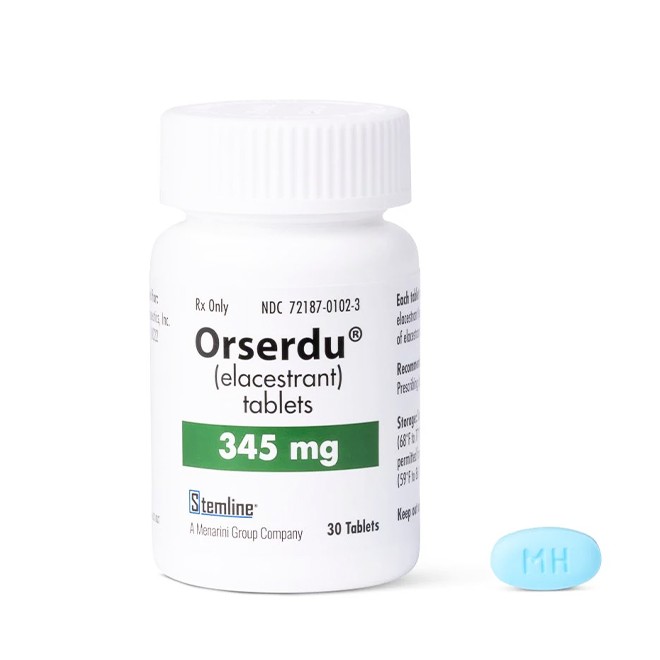
Elacestrant (Orserdu) is an estrogen receptor antagonist, primarily indicated for the treatment of estrogen receptor (ER)-positive, human epidermal growth factor receptor 2 (HER2)-negative, ESR1-mutated advanced or metastatic breast cancer. It is suitable for postmenopausal women or adult male patients who have experienced disease progression after receiving at least one line of endocrine therapy.
Side Effects of Elacestrant (Orserdu)
Digestive System
Nausea: Incidence rate of 35%.
Vomiting: Incidence rate of 19%.
Diarrhea: Incidence rate of 13%.
Constipation: Incidence rate of 12%.
Abdominal pain: Incidence rate of 11%.
Abnormal Biochemical Indicators
Increased cholesterol: Incidence rate of 30%.
Increased triglycerides: Incidence rate of 27%.
Increased aspartate aminotransferase (AST): Incidence rate of 29%.
Increased alanine aminotransferase (ALT): Incidence rate of 17%.
Decreased sodium: Incidence rate of 16%.
Severe Side Effects of Elacestrant (Orserdu)
Dyslipidemia Risk
Elacestrant may cause hypercholesterolemia and hypertriglyceridemia, with incidence rates of 30% and 27% respectively.
Among these, the incidence rates of Grade 3 and Grade 4 hypercholesterolemia are 0.9%, and those of Grade 3 and Grade 4 hypertriglyceridemia are 2.2%.
Monitoring requirements: Test lipid profile before starting treatment.
Conduct regular monitoring during treatment.
Embryo-Fetal Toxicity
Based on animal study results and its mechanism of action, elacestrant may cause fetal harm when administered to pregnant women.
Preventive measures: Women of reproductive potential are advised to use effective contraceptive measures during treatment and for 1 week after the last dose.
Male patients with female partners of reproductive potential are advised to use effective contraceptive measures during treatment and for 1 week after the last dose.
Hepatic Toxicity Reactions
Increased AST: Incidence rate of 29%.
Increased ALT: Incidence rate of 17%.
Precautions for Elacestrant (Orserdu)
Important Drug Interactions
CYP3A4 inhibitors and inducers: Strong and moderate CYP3A4 inhibitors: Avoid concurrent use with elacestrant.
Strong and moderate CYP3A4 inducers: Avoid concurrent use with elacestrant.
P-gp and BCRP substrates: When minimal concentration changes may lead to severe or life-threatening side effects, the doses of P-gp substrates and BCRP substrates should be reduced according to their prescribing information.
Administration Requirements
345 mg once daily.
Take with food to reduce nausea and vomiting.
Take the medication at approximately the same time each day.
Management of Special Situations
Missed dose by more than 6 hours: Skip the dose and take the next dose at the regularly scheduled time the next day.
Vomiting occurs: Skip the dose and take the next dose at the regularly scheduled time the next day.
Mandatory Monitoring Items
Lipid profile: Before treatment and regularly during treatment.
Liver function: Conduct regular monitoring.
Clinical symptoms: Closely observe adverse reactions.

Free Inquiry