

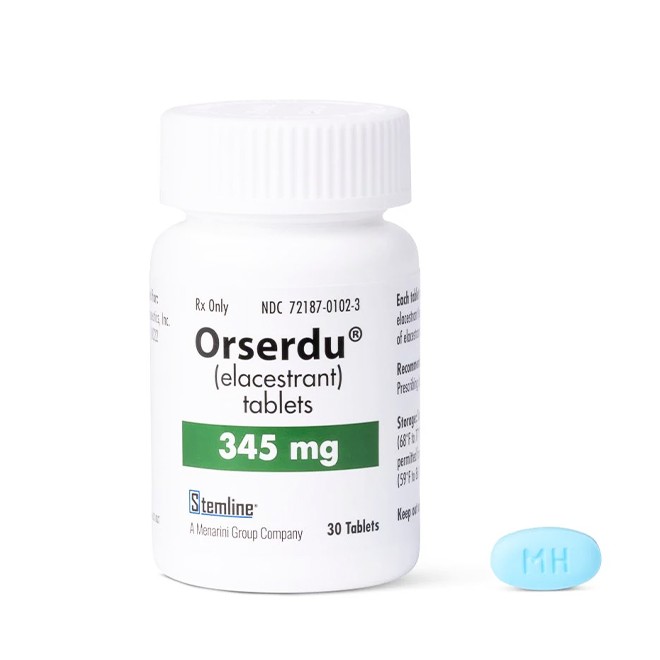
Elacestrant (Orserdu) is an estrogen receptor antagonist, primarily indicated for the treatment of postmenopausal women or adult men with ER-positive, HER2-negative, ESR1-mutated advanced or metastatic breast cancer who have experienced disease progression after at least one line of endocrine therapy.
Dosage and Administration, Recommended Dose of Elacestrant (Orserdu)
Recommended Dose and Administration Regimen
The recommended dose of elacestrant is 345 mg orally once daily, taken with food, until disease progression or the occurrence of unacceptable toxicity.
Patient Selection Requirements
Before initiating elacestrant treatment, the presence of ESR1 mutation must be confirmed through plasma sample testing using an FDA-approved detection method.
Medication Timing Management
Elacestrant should be taken at approximately the same time each day.
If a dose is missed by more than 6 hours or vomiting occurs after administration, the missed dose should be skipped, and the next dose should be taken at the regularly scheduled time on the following day.
Administration Precautions
Elacestrant tablets should be swallowed whole and must not be chewed, crushed, or split before swallowing.
Do not take any elacestrant tablets that are chipped, cracked, or appear damaged.
Dose Adjustment of Elacestrant (Orserdu)
Dose Adjustment Based on Adverse Reactions
First dose reduction: Decrease from 345 mg once daily to 258 mg once daily (three 86 mg tablets).
Second dose reduction: Decrease from 258 mg once daily to 172 mg once daily (two 86 mg tablets).
If a further dose reduction below 172 mg once daily is required, elacestrant should be permanently discontinued.
Graded Management of Adverse Reactions
Grade 1 adverse reactions: Continue elacestrant at the current dose level.
Grade 2 adverse reactions: Consider suspending elacestrant until recovery to ≤ Grade 1 or baseline level, then resume at the same dose level.
Grade 3 adverse reactions: Suspend elacestrant until recovery to ≤ Grade 1 or baseline level, then resume at the next lower dose level.
Grade 4 adverse reactions: Suspend elacestrant until recovery to ≤ Grade 1 or baseline level, then resume at a reduced dose level.
If Grade 4 or intolerable adverse reactions recur, elacestrant must be permanently discontinued.
Medication Use in Special Populations for Elacestrant (Orserdu)
Patients with Hepatic Impairment
Patients with mild hepatic impairment (Child-Pugh A): No dose adjustment is required.
Patients with moderate hepatic impairment (Child-Pugh B): Reduce the dose to 258 mg once daily.
Patients with severe hepatic impairment (Child-Pugh C): Avoid the use of elacestrant.
Patients with Renal Impairment
No dose adjustment is required for patients with severe renal impairment when using elacestrant.
Pregnant and Lactating Women
Pregnancy: Use of elacestrant in pregnant women may cause fetal harm. Women of reproductive potential are advised to use effective contraceptive measures during treatment and for 1 week after the last dose.
Lactation: Breastfeeding is prohibited during treatment and for 1 week after the last dose.

Free Inquiry