info@seagull-health.com
SeagullHealth
语言:
search
new
What kind of drug is Selumetinib?
502
Article source: Seagull Pharmacy
Jun 24, 2025

Selumetinib is a targeted therapy that specifically targets specific types of neurofibromatosis. This article will introduce the basic information, dosage, and precautions of Selumetinib in detail to help patients and their families better understand and use the drug.

What kind of drug is Selumetinib?

Selumetinib is a targeted therapy that inhibits the proliferation of tumor cells by inhibiting MEK1 and MEK2 enzymes, providing a new therapeutic option for NF1-associated PN.

Basic information about the drug

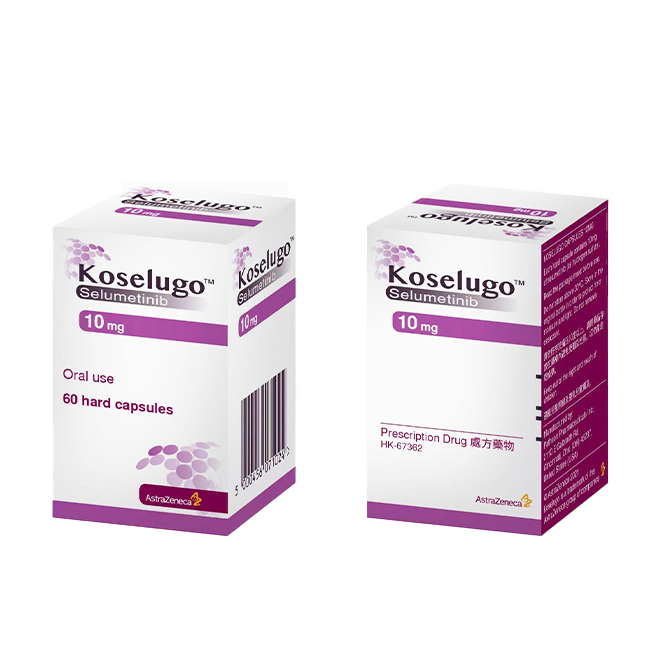
Selucitinib (known as Koselugo, other nicknames include Coselugo and Selumetinib Bisulfate Capsules) was developed by AstraZeneca in the United Kingdom and officially approved for marketing in China in May 2023. It is primarily used to treat pediatric patients 2 years of age and older with neurofibromatosis type 1 (NF1) with symptomatic plexiform neurofibromas (PN) that cannot be surgically removed.

Main ingredients and dosage forms

The main ingredient of Koselugo is Selumetinib sulfate, and its dosage form is capsules, which are available in two specifications: 10mg and 25mg, respectively. The 10 mg capsule is a white opaque hard capsule labeled "SEL10", while the 25 mg capsule is a blue opaque hard capsule labeled "SEL25".

Knowing the specific ingredients and dosage forms of a drug can help to correctly identify the drug and avoid misuse.

Dosage of Selumetinib dosage

Following your doctor's guidance for dose adjustments is important to maintain efficacy and reduce side effects.

Recommended dose

The recommended dose of Selumetinib is given by body surface area (BSA) at a single recommended dose of 25 mg/m² orally twice daily (approximately every 12 hours). The dose should be adjusted on an individual basis and rounded up to the nearest dose of 5 mg or 10 mg (maximum dose of 50 mg at a time).

Missed dose management and vomiting coping

If you forget to take the medication, you can only take it if it is more than 6 hours before the next dose. If vomiting occurs after taking the drug, no additional supplemental dose is required and the next dose should be given as planned.

Proper management of missed doses and response to vomiting can help maintain stable plasma levels, thereby improving treatment outcomes.

Dose adjustments

Considering individual safety and tolerability, Selumetinib may need to be suspended, tapered, or permanently discontinued. A medical professional should be consulted for specific tariff regimens.

Regularly assessing the patient's response and adjusting the treatment regimen accordingly can optimize treatment outcomes and reduce adverse effects.

Precautions for Selumetinib

Paying close attention to changes in heart function and adjusting treatment strategies in a timely manner can help prevent serious heart complications.

Cardiomyopathy surveillance

Left ventricular ejection fraction (LVEF) should be assessed by echocardiography prior to initiation of treatment, every three months for the first year of treatment, and every six months thereafter, and as clinically indicated. If the LVEF is less than ≥10% of baseline, Selumetinib should be suspended, reduced, or permanently discontinued.

See-to-toxicity management

Selumetinib may cause serious visual toxicity, including retinal vein occlusion (RVO) and retinal pigment epithelium detachment (RPED). It is recommended to have a full ophthalmologic evaluation before initiating treatment and at regular intervals during treatment to assess changes in visual acuity.

Regular eye exams and early detection of vision problems can effectively manage the risk of visual toxicity.

Gastrointestinal toxicity and skin toxicity

Selumetinib may cause gastrointestinal toxicity (e.g., diarrhea, colitis, etc.) and skin toxicity (e.g., skin rash, acne-like rash, etc.). Take antidiarrheal drugs (such as loperamide) immediately when you have unformed loose stools and increase your fluid intake; Monitor for severe rashes.

Proactive management and coping with these common side effects not only reduces patient discomfort but also improves treatment adherence.

Note: For internal discussion among medical personnel only. For specific medication, please consult the attending physician. Drug information may change over time. For the latest information, we recommend adding a medical consultant or consulting for free online.
Selumetinib(Koselugo)
KOSELUGO (selumetinib) is indicated for the treatment of pediatric patients...
WeChat Scan
Free Inquiry
Recommended Articles
What diseases is Selumetinib treating?
Selumetinib is a targeted therapy drug that is primarily used to treat specific types of neurofibromatosis. This article will provide a detailed description of who Selumetinib can be treated...
Is there anything to pay attention to when taking Belzutifan(Welireg)?
Befativan(WELIREG) is an innovative drug that offers a new option for the treatment of von Hippel-Lindau (VHL) syndrome. While understanding the drug use and adverse reactions of its special populatio...
The efficacy of Belzutifan
Belzutifan(Welireg) is a drug specifically designed to target tumors associated with von Hippel-Lindau (VHL) syndrome. By targeting HIF-2α, it is able to effectively inhibit the abnormal proliferation...
What are the adverse effects of Belzutifan(WELIREG)?
Although Belzutifan(WELIREG) is an innovative drug for the treatment of von Hippel-Lindau (VHL) syndrome, although it brings new hope for treatment to patients, the adverse reactions that may be cause...
Is Selumetinib a targeted drug?
Selumetinib is a targeted therapy that specifically targets specific genetic mutations, primarily for the treatment of plexiform neurofibromas associated with neurofibromatosis type 1. This artic...
Efficacy of Selumetinib
Selumetinib is a targeted drug specifically designed for the treatment of neurofibromatosis type 1 (NF1)-associated plexiform neurofibromas (PN). This article will detail the efficacy of Selumetinib, ...
Selumetinib effect
Selumetinib is a targeted therapy drug that is primarily used to treat specific types of neurofibromatosis. This article will delve into the mechanism of action of Selumetinib, its clinical efficacy, ...
Selumetinib dosage
Selumetinib(Koselugo) has demonstrated significant clinical efficacy as a kinase inhibitor in pediatric patients with neurofibromatosis type 1 (NF1) who are 2 years of age and older with symptomatic, ...
Related Articles
How to Purchase Selumetinib (Koselugo)
Selumetinib (Koselugo) is a MEK1/2 kinase inhibitor specifically indicated for the treatment of symptomatic, inoperable plexiform neurofibromas (PN) in pediatric patients aged 1 year and older with ne...
How to Use Selumetinib (Koselugo)
Selumetinib (Koselugo) is a MEK1/2 kinase inhibitor that plays a key role in the treatment of symptomatic, inoperable plexiform neurofibromas (PN) associated with neurofibromatosis type 1 (NF1) in chi...
What is Selumetinib (Koselugo)?
Selumetinib (Koselugo) is a kinase inhibitor primarily used for the treatment of specific types of nervous system tumors. As a targeted therapy drug, its unique pharmacological effects provide an impo...
What is Selumetinib (Koselugo)?
Selumetinib (Koselugo) is a targeted therapeutic drug for diseases caused by specific gene mutations. Developed by AstraZeneca, it was first approved for marketing by the U.S. FDA in 2020.What is Selu...
Dosage Overview: Selumetinib
Selumetinib is a targeted drug specifically designed for the treatment of neurofibromatosis type 1 (NF1)-associated plexiform neurofibromas (PN). This article will provide a detailed description ...
The efficacy of the neurofibromatosis type 1 drug Selumetinib and the management of precautions
Selumetinib is the first and only drug approved in China for the treatment of pediatric patients with neurofibromatosis type 1 (NF1) with symptomatic and inoperable plexiform neurofibromas (PN), ...
Instructions for Selumetinib: action and efficacy, dosage, side effects, precautions
Selumetinib is a MEK1/2 inhibitor developed by AstraZeneca and approved by the US FDA in April 2020 for the treatment of neurofibromatosis type 1 (NF1)-associated plexiform neurofibromas in child...
Side effects of Selumetinib
Selumetinib is a MEK1/2 inhibitor that has shown promising efficacy in the treatment of neurofibromatosis type 1 (NF1)-associated plexiform neurofibromas, but also comes with a specific risk of s...
New Drugs
Infigratinib(Truseltiq)
Treatment of previously treated, unresectable locally advanced or metastatic...
Opicapone(Ongentys)
Opicapone(Ongentys)
Adjunctive treatment to levodopa/carbidopa for reducing "off" episodes in...
Deflazacort(Emflaza)
Treatment of Duchenne muscular dystrophy (DMD) in patients aged 2 years and...
Faricimab-svoa(Vabysmo)
Treatment of neovascular age-related macular degeneration, diabetic macular...
Counselling Service
Global Drug Search
Clinical Research Recruitment
Overseas Medical Treatment
Remote Consultations
Note: Our medical consultant will contact you as soon as possible. We promise to strictly protect your privacy.
Submit
Business
  • Core products
  • Antitumor drugs
  • General drug
  • Antiviral drugs
  • Biological agents
Contact Us 
  • mailbox:info@lucius.la
Welcome to consult
ucius Pharmaceuticals (Lao) Co.,Ltd All rights reserved