info@seagull-health.com
SeagullHealth
语言:
search
new
Efficacy of Defibrotide
501
Article source: Seagull Pharmacy
Jul 10, 2025

Defibrotide is an important therapeutic drug that shows unique clinical value in specific medical fields. Its core mechanism of action and wide application background make it a key choice for the treatment of hepatic veno-occlusive disease. This article will analyze its efficacy, drug interactions and pharmacokinetics, and systematically explain its medical characteristics in different dimensions.

Efficacy of Defibrotide

Veno-occlusive disease (VOD) is a serious complication that may occur after hematopoietic stem cell transplantation, characterized by obstruction of intrahepatic venules and organ dysfunction. Defibrotide provides patients with an effective treatment through a multi-target mechanism of action.

Mechanism of Action and Target Regulation

Defibrotide inhibits platelet activation and thrombosis by regulating endothelial cell function, while promoting fibrinolysis. Its targets include key molecules such as PAI-1, tPA and vWF. By balancing the coagulation and fibrinolytic systems, it repairs damaged vascular endothelium and improves microcirculatory disorders. This multi-effect mechanism enables it to alleviate the pathological progression of VOD from the root.

Clinical Efficacy and Survival Benefit

Clinical trial data show that Defibrotide significantly improves the survival rate of VOD patients. Compared with the historical control group, patients treated with Defibrotide showed a significant advantage in 60-day survival rate. It is well tolerated and has controllable adverse reactions, especially in critically ill patients with renal or pulmonary dysfunction, showing irreplaceable therapeutic value.

Overall, Defibrotide improves the prognosis of VOD patients through its unique pharmacological effects, and its clinical evidence supports its core position in complex cases.

Drug interactions of Defibrotide

Drug interactions are an important consideration in clinical applications. The fibrinolytic activity of Defibrotide requires special caution when used in combination with certain drugs.

Synergistic risks with antithrombotic drugs

The combination of Defibrotide with antithrombotic or fibrinolytic drugs such as heparin and alteplase may lead to a significant increase in bleeding risk. Its mechanism stems from the synergistic activation of the fibrinolytic system by both, which may break through the physiological hemostatic barrier. Clinical guidelines clearly recommend that relevant anticoagulants should be discontinued before starting Defibrotide treatment and coagulation function indicators should be monitored.

Combined medication management strategy

For patients who must use vasoactive drugs, it is necessary to ensure that the hemodynamics are stable before Defibrotide treatment. At the same time, avoid infusion with other intravenous drugs through the same route to reduce the risk of physical incompatibility. During treatment, a multidisciplinary collaboration mechanism needs to be established to dynamically evaluate the bleeding tendency and adjust the regimen in a timely manner.

By reasonably avoiding the risk of drug interactions, the therapeutic benefit of Defibrotide can be maximized and the patient's medication safety can be maintained.

Pharmacokinetics of Defibrotide

The pharmacokinetic properties directly affect the clinical use of the drug and the stability of its efficacy. The in vivo process of Defibrotide has clear characteristics.

Absorption and distribution characteristics

After intravenous infusion, the blood concentration of Defibrotide reaches a peak at the end of the infusion. Its distribution volume is large, indicating that the drug can be widely distributed in tissue areas rich in vascular endothelium. This characteristic is highly consistent with its targeted repair of vascular damage, and it is clear that the local therapeutic concentration reaches the target.

Metabolism and elimination pathways

Defibrotide is mainly metabolized by enzymatic hydrolysis, and the metabolites are excreted by the kidneys. It has a short half-life and needs to be administered every 6 hours to maintain an effective blood concentration. Special populations such as those with renal insufficiency need to closely monitor the risk of drug accumulation and adjust the infusion frequency or dose if necessary.

Based on its pharmacokinetic characteristics, standardized dosing regimen and infusion management are important foundations for ensuring the therapeutic effect.

Note: For internal discussion among medical personnel only. For specific medication, please consult the attending physician. Drug information may change over time. For the latest information, we recommend adding a medical consultant or consulting for free online.
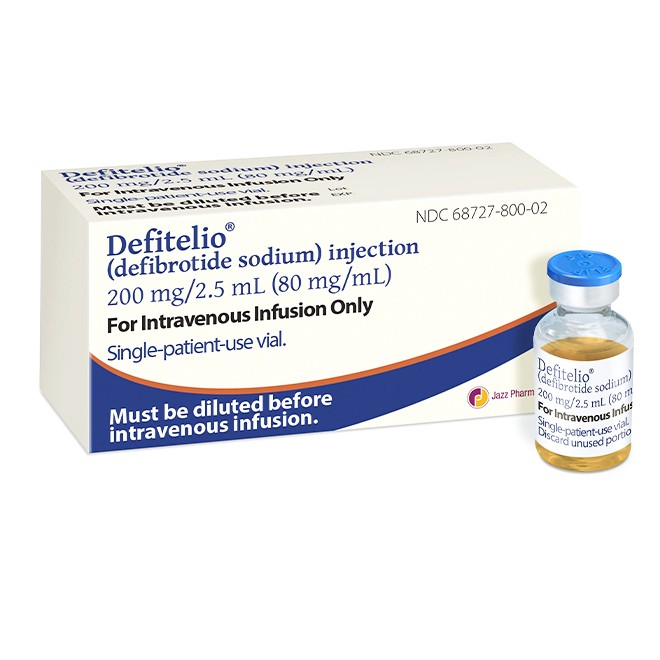
Defibrotide(Defitelio)
diagnosed with hepatic veno-occlusive disease (VOD), also known as sinusoidal...
WeChat Scan
Free Inquiry
Recommended Articles
Defitelio Medication Guide
Defitelio is a key drug used to treat hepatic veno-occlusive disease (VOD) after hematopoietic stem cell transplantation. Its mechanism of action involves endothelial cell protection and coagulat...
How much does a Defitelio cost?
Defitelio is a special drug for the treatment of hepatic veno-occlusive disease (VOD) after hematopoietic stem cell transplantation, produced by Jazz Pharmaceuticals of Ireland. At present, Defit...
How to buy Defitelio
Defitelio is an important drug for the treatment of hepatic veno-occlusive disease after hematopoietic stem cell transplantation. Since it has not yet been launched in China and is expensive, spe...
What is Defitelio? How effective is it in treating transplant-associated thrombotic microangiopathy (TA-TMA)?
Defitelio is a drug specifically used to treat specific diseases and plays an important role in the medical field. The following will introduce the drug properties, therapeutic applications, possible ...
Side effects of Defibrotide
Defibrotide is a widely recognized blood treatment drug in the international market. It is suitable for patients with hepatic veno-occlusive disease (VOD) after hematopoietic stem cell transplant...
What to pay attention to when using Defibrotide
Defibrotide stabilizes and protects endothelial cells, inhibits thrombosis, and promotes fibrinolysis, thereby improving coagulation dysfunction, repairing vascular wall damage, and relieving the...
Cobimetinib targeted drug
Cobimetinib is a targeted therapy drug that blocks the tumor cell proliferation signaling pathway by inhibiting the activity of MEK1/2 protein kinases. It plays an important role in the treatment of u...
Cobimetinib Instructions
Cobimetinib is a targeted therapy drug mainly used to treat unresectable or metastatic melanoma with BRAF V600E/K mutation. The drug is a MEK1/MEK2 inhibitor that inhibits tumor growth by blocking cel...
Related Articles
Defibrotide(Defitelio):Clinical Uses, Recommended Dosage, Treatment Effect
Ogsiveo inhibits the activation of Notch receptors by suppressing γ-secretase, thereby interfering with certain cellular signaling pathways and inhibiting the proliferation of tumor cells. It has not ...
Where to buy defibrotide at a lower price?
Defibrotide is an oligonucleotide drug derived from natural DNA degradation products, with antithrombotic and fibrinolytic properties. It is mainly used for the treatment of hepatic veno-occlusive dis...
Dosage and Administration of Defibrotide (Defitelio)
Defibrotide is a drug used to treat hepatic veno-occlusive disease (VOD), and its main component is a thrombolytic enzyme. VOD is a rare and serious liver disease characterized by impaired blood circu...
Precautions for Defibrotide
Defibrotide generic is a drug used to treat hepatic veno-occlusive disease. Even though it is a generic drug, there are still some precautions to note during use to ensure safety and effectiveness. Th...
Side Effects of Defibrotide
Defibrotide is a drug used to treat hepatic veno-occlusive disease, primarily functioning to promote the protection and repair of vascular endothelial cells, and alleviate thrombosis and damage caused...
How much does Defitelio cost per box?
Defibrotide is a mixture of single-stranded oligonucleotides derived from the genomic DNA of calf lung or porcine intestinal mucosa. It is indicated for adult and pediatric patients with hepatic veno-...
Indications for Defibrotide
Defibrotide is a medication used to treat hepatic veno-occlusive disease (VOD). Before deciding whether to use defibrotide, doctors will evaluate the patient's condition and related factors. This ...
Therapeutic Effects of Defibrotide
Defibrotide, as a commonly used medication, has gained widespread recognition for its efficacy in the treatment of various diseases. However, like many drugs, when used concurrently with other medicat...
New Drugs
Infigratinib(Truseltiq)
Treatment of previously treated, unresectable locally advanced or metastatic...
Opicapone(Ongentys)
Opicapone(Ongentys)
Adjunctive treatment to levodopa/carbidopa for reducing "off" episodes in...
Deflazacort(Emflaza)
Treatment of Duchenne muscular dystrophy (DMD) in patients aged 2 years and...
Faricimab-svoa(Vabysmo)
Treatment of neovascular age-related macular degeneration, diabetic macular...
Counselling Service
Global Drug Search
Clinical Research Recruitment
Overseas Medical Treatment
Remote Consultations
Note: Our medical consultant will contact you as soon as possible. We promise to strictly protect your privacy.
Submit
Business
  • Core products
  • Antitumor drugs
  • General drug
  • Antiviral drugs
  • Biological agents
Contact Us 
  • mailbox:info@lucius.la
Welcome to consult
ucius Pharmaceuticals (Lao) Co.,Ltd All rights reserved