info@seagull-health.com
SeagullHealth
语言:
search
new
Guidelines for the use of Elacestrant
503
Article source: Seagull Pharmacy
Jun 19, 2025

Elacestrant(Orserdu) is a novel estrogen receptor antagonist for patients with specific types of breast cancer. This article will systematically explain the key information of the drug from three aspects: medication guidelines, precautions and indications, so as to help patients and medical practitioners better understand its clinical application and management points.

Guidelines for the use of Elacestrant

Elacestrant was developed by Stemline in the United States and approved by the FDA for marketing in 2023. The drug targets ER-positive, HER2-negative advanced or metastatic breast cancer with ESR1 mutations by inhibiting estrogen receptor activity. The following analyzes its usage specifications from two aspects: basic information and usage and dosage.

Basic information about the drug

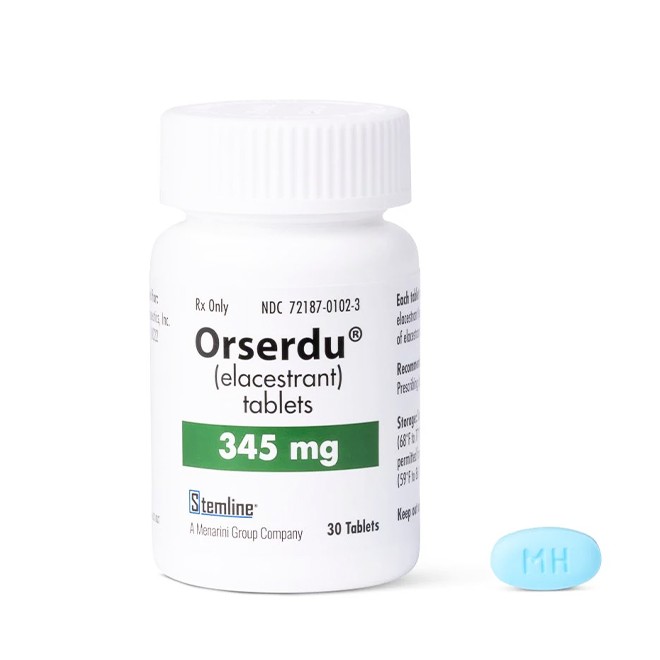
Elacestrant is available as a tablet with 345 mg and 86 mg. The original drug is produced by Stemline in the United States; Lucius Laos offers generic drugs at significantly lower prices. Distinguishable tablet properties: 345mg is an oval light blue tablet marked "MH"; 86 mg is a round tablet of the same color, labeled "ME". Storage needs to be sealed in the dark, and the temperature should be controlled at 15°C-30°C.

Standardize the medication regimen

The recommended dose is 345 mg daily with a meal and swallowed whole to reduce gastrointestinal reactions. If you miss a dose for more than 6 hours, you need to skip the dose, and you do not need to make up the dose after vomiting. Patients with moderate to severe liver impairment need to adjust the dose: Child-Pugh grade B is reduced to 258 mg, and grade C is contraindicated. Combination with CYP3A4 inducers/inhibitors may affect efficacy and should be strictly avoided.

It is recommended to formulate a treatment plan under the guidance of a professional physician and regularly monitor drug reactions.

Precautions for the administration of Elacestrant

The clinical use of Elacestrant needs to balance efficacy and safety. The following is to clarify the key points of risk prevention and control in the treatment process from the aspects of adverse reaction management and drug use in special populations.

Prevention and control of adverse reactions

More than 10% of patients have musculoskeletal pain, nausea, and dyslipidemia, with grade 3 to 4 hypercholesterolemia occurring in 0.9% to 2.2%. Baseline blood lipid data should be established before medication, and monitored every 3 months during treatment. If severe vomiting or abnormal liver function occurs, the dose should be adjusted or the dose should be suspended.

Special population management

Pregnant women may cause fetal malformations, and strict contraception is required until 1 week after discontinuation. Breastfeeding women should stop breastfeeding. Safety data are lacking in children and older patients over 75 years of age and require careful evaluation. Patients with hepatic impairment need to adjust the dose according to the Child-Pugh grade, and patients with renal insufficiency do not need special adjustments.

Through dynamic monitoring and precise management, the treatment risk can be minimized while ensuring the efficacy, and safe medication support can be provided for different groups of patients.

Indications for patients with Elacestrant

The drug has a clear therapeutic value for specific breast cancer subtypes. The following analyzes its clinical positioning from the aspects of applicable population and treatment mechanism.

Precision treatment of groups

It is suitable for postmenopausal women or adult men with ER/HER2- advanced breast cancer and ESR1 mutation confirmed by genetic testing. In these patients, after failure of at least one endocrine therapy, Elacestrant significantly prolongs progression-free survival and is the preferred second-line treatment.

Mechanism of action analysis

The drug is a selective estrogen receptor degrader (SERD), and alastrone blocks the estrogen signaling pathway and induces receptor degradation by competitively binding to the ERα receptor. Compared with fulvestrant, its oral administration method significantly improves the convenience of medication and has a stronger inhibitory effect on ESR1 mutant strains.

Clarifying the scope of indications and mechanism of action will help screen the beneficiary population and provide more precise treatment options for patients with advanced breast cancer.

Note: For internal discussion among medical personnel only. For specific medication, please consult the attending physician. Drug information may change over time. For the latest information, we recommend adding a medical consultant or consulting for free online.
Elacestrant(Orserdu)
Advanced or metastatic breast cancer that is ER-positive, HER2-negative, and...
WeChat Scan
Free Inquiry
Recommended Articles
How to use Elacestrant?
Elacestrant is a novel estrogen receptor antagonist suitable for patients with specific types of advanced breast cancer. Correct use of this drug can not only improve the efficacy, but also reduce the...
Dosage and Administration of Elacestrant(Orserdu)
Elacestrant(Orserdu) is a novel estrogen receptor antagonist designed for patients with ER-positive, HER2-negative advanced or metastatic breast cancer harboring ESR1 mutations. It inhibits the growth...
Elacestrant detailed instructions, precautions, efficacy, dosage introduction
Elacestrant, is an estrogen receptor antagonist used to treat ER-positive, HER2-negative, ESR1-mutated advanced or metastatic breast lesions. It blocks the growth and spread of diseased cells by inhib...
Elacestrant is used for the treatment of advanced or metastatic breast lesions
Elacestrant, also known as Orserdu, is an estrogen receptor antagonist used to treat advanced or metastatic breast lesions. It is indicated for postmenopausal women or adult men, especially those who ...
Is Elacestrant(ORSERDU) effective?
The launch of the breast disease treatment drug ORSERDU/Elacestrant has brought new vitality to countless patients. This drug selectively degrades estrogen receptors and effectively blocks the growth ...
How effective is Elacestrant?
In the treatment of breast diseases, the emergence of Elacestrant is of great significance. As an oral SERD, it is able to directly degrade estrogen receptors, thereby inhibiting the growth of disease...
What is the therapeutic effect of Elacestrant?
Elacestrant was developed and produced by Stemline, the United States, and was approved by the U.S. Food and Drug Administration (FDA) in January 2023, becoming the only oral selective estrogen recept...
Side effects of Elacestrant
Elacestrant is a novel estrogen receptor antagonist that provides an important therapeutic option for specific breast cancer patients. However, similar to other drugs, a series of side effects may occ...
Related Articles
What are the Precautions for Taking Elacestrant (Orserdu)?
Elacestrant (Orserdu) is the first oral selective estrogen receptor degrader (SERD). It was approved by the FDA in 2023 for the treatment of advanced or metastatic breast cancer that is estrogen recep...
Side Effects of Elacestrant (Orserdu)
Elacestrant (Orserdu) is an estrogen receptor antagonist, primarily indicated for the treatment of estrogen receptor (ER)-positive, human epidermal growth factor receptor 2 (HER2)-negative, ESR1-mutat...
Dosage and Administration, Recommended Dose of Elacestrant (Orserdu)
Elacestrant (Orserdu) is an estrogen receptor antagonist, primarily indicated for the treatment of postmenopausal women or adult men with ER-positive, HER2-negative, ESR1-mutated advanced or metastati...
What Are the Indications of Elacestrant (Orserdu)?
Elacestrant (Orserdu) is a novel estrogen receptor antagonist. It was approved for marketing by the U.S. FDA in 2023, providing a precise treatment option for patients with advanced breast cancer harb...
What Are the Purchase Channels for Elacestrant (Orserdu)?
Elacestrant (Orserdu) is a novel estrogen receptor antagonist that plays an important role in the treatment of ER-positive, HER2-negative, ESR1-mutated advanced or metastatic breast cancer.What Are th...
Side effects caused by Elacestrant
Elacestrant, the main component of Elacestrant, is mainly adapted to postmenopausal women or adult men with breast-related diseases. As a novel selective estrogen receptor degrader, it has shown signi...
Side effects of Elacestrant
Elacestrant is a novel estrogen receptor antagonist that provides an important therapeutic option for specific breast cancer patients. However, similar to other drugs, a series of side effects may occ...
What is the therapeutic effect of Elacestrant?
Elacestrant was developed and produced by Stemline, the United States, and was approved by the U.S. Food and Drug Administration (FDA) in January 2023, becoming the only oral selective estrogen recept...
New Drugs
Infigratinib(Truseltiq)
Treatment of previously treated, unresectable locally advanced or metastatic...
Opicapone(Ongentys)
Opicapone(Ongentys)
Adjunctive treatment to levodopa/carbidopa for reducing "off" episodes in...
Deflazacort(Emflaza)
Treatment of Duchenne muscular dystrophy (DMD) in patients aged 2 years and...
Faricimab-svoa(Vabysmo)
Treatment of neovascular age-related macular degeneration, diabetic macular...
Counselling Service
Global Drug Search
Clinical Research Recruitment
Overseas Medical Treatment
Remote Consultations
Note: Our medical consultant will contact you as soon as possible. We promise to strictly protect your privacy.
Submit
Business
  • Core products
  • Antitumor drugs
  • General drug
  • Antiviral drugs
  • Biological agents
Contact Us 
  • mailbox:info@lucius.la
Welcome to consult
ucius Pharmaceuticals (Lao) Co.,Ltd All rights reserved